
Text and photo images
©2013 Richard Leonard.


Today, the Union Pacific main from Omaha west through Nebraska and Wyoming is a busy thoroughfare for intermodal hotshots and unit coal trains. In the 1950s it was the pathway for fast movements of perishables from the West Coast to the eastern markets. Long trains of refrigerator cars passed slowly through icing stations where their cooling capacity was refreshed, then sped on their way. Cattle still moved by rail from Western ranch to Midwest stockyard, and the line was constantly busy with the usual flow of merchandise in both directions, plus the Overland Route passenger streamliners.
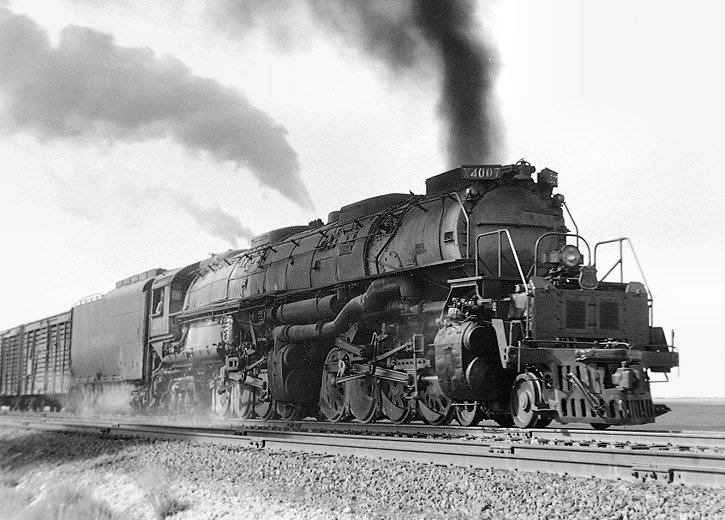
The Union Pacific had put the bulk of its remaining steam locomotives into storage, but a surge of traffic in the summer of 1957 taxed the capacity of its diesel and gas turbine power and resulted in the recall of much of its modern, high-horsepower steam fleet. Knowing that the "Big Boys," Challengers and Northerns could still be seen in their natural habitat and not just in a scrap line, 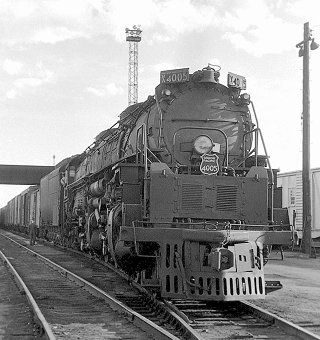 my father planned a stay in Laramie, Wyoming, as a sequel to a family trip to visit relatives in the Denver area. Dad, who had struggled through the Great Depression, never lost a chance to economize, and financed our stopoff in Laramie by filling in for a vacationing minister at the local Methodist church. This arrangement also gave us the parsonage as sleeping quarters for an extended weekend, and a base of operations from which to explore not just the Laramie yard and engine terminal but also the western approach to famed Sherman Hill. My brother, the late David V. Leonard, and I both put our cameras to work and took duplicate views of many scenes. Some of these photos (as indicated) are his work, as his camera with a larger negative produced slightly better images.
I took the above dramatic photo of "Big Boy" No. 4007 battling up the grade with an eastbound, the consist of which included a string of cattle cars behind the tender. (This photo appears also in Brian Solomon's book Locomotive, published in 2001 by Motorbooks, now out of print). No. 4007 was a member of the first class of 4-8-8-4s constructed by American Locomotive Company in 1941. These locomotives, a type unique to the Union Pacific, had two sets of 68-inch disc drivers and 23-3/4x32-inch cylinders, a boiler pressure of 300 pounds per square inch, and a tractive effort of 135,375 pounds. This first group had a an evaporative heating surface of 5889 square feet, and 2465 square feet of superheating surface.
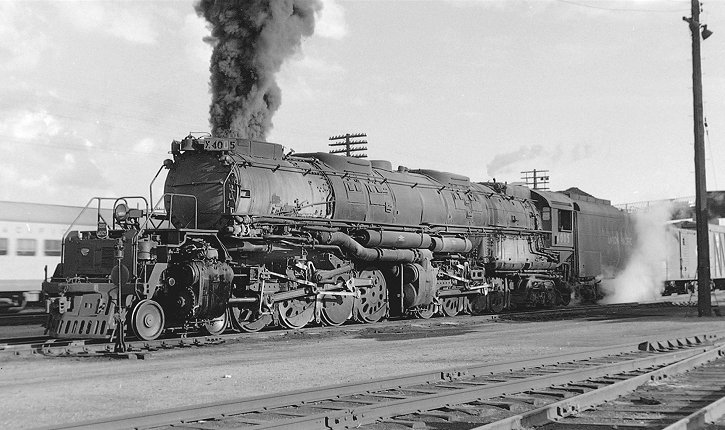
The 4-8-8-4s were simple articulateds; the front set of drivers and pilot wheels could swivel to accommodate track curvature, and both sets of cylinders used steam directly from the boiler. (On a compound articulated, the front set of cylinders reused steam from the rear set.) No. 4007 was not preserved, but eight other locomotives in this class still exist. One of them is No. 4005, shown in a head-on view demonstrating its articulation as it begins to pull its train onto the main track in the Laramie yard. Below, No. 4005 appears as it prepares to get under way, emitting a heavy output of black smoke. Unlike some other railroads, such as the New York Central, whose engineering departments took great pains to maximize fuel efficiency in steam locomotives, the Union Pacific had its own company supply of lower-quality coal and was not overly concerned about its locomotives' consumption of fuel. No. 4005 is on display in Denver (formerly at the Forney Transportation Museum).
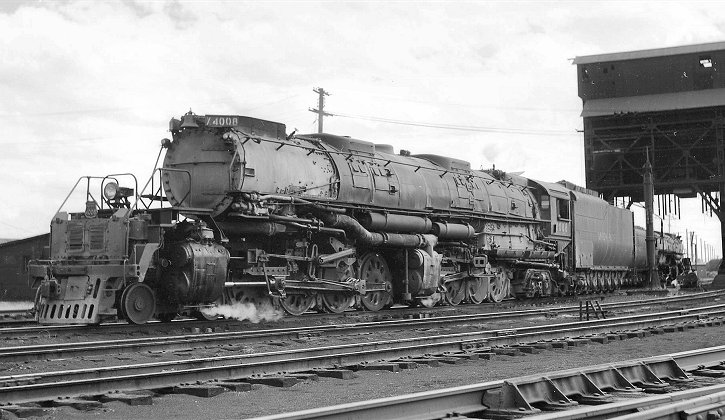
Above, No. 4008 (not preserved) is standing by for its next assignment near the Laramie coaling tower, in a photo by my brother. Despite their size — they had a wheelbase of almost 131 feet, a massive grate area of 150.3 square feet, and a weight of 1,120,000 pounds with their pedestal-type tender — the Big Boys were capable of seventy miles per hour. A second group was built in 1944 to help shoulder the load of heavy wartime traffic. . It was an incredible, never-to-be-repeated experience to view them at the head of the Union Pacific's long transcontinental freights, singly or even double heading with the UP's unique gas turbine-electric locomotives. For more shots of the Big Boys in operation and a few in static display, visit Richard Leonard's Big Boys & Challengers Gallery. Further information on the 4-8-8-4s may be found on Wes Barris' Union Pacific Big Boys page.
Amidst this feast of high-horsepower steam, we did not neglect the smaller, older locomotives such as Consolidation No. 535, of class C-57 (Baldwin Locomotive Works, 1903), which was switching the Laramie yard and local industries. Her tender, and hazy exhaust, identify her as an oil burner. No. 535 (renumbered to 6535 around 1957 to make way for GP-9 diesels) is preserved at Laramie. She had 21½x30-inch cylinders, a boiler pressure of 190 pounds per square inch, and a tractive effort of 39,290 pounds. I took this photo, with downdown Laramie in the background, from the footbridge that spanned the terminal area. The photo appears on the cover of a tour brochure, Railroads of Albany County - Tracking the Past, produced by the Albany County Historic Preservation Board for the Laramie Area Visitor Center.
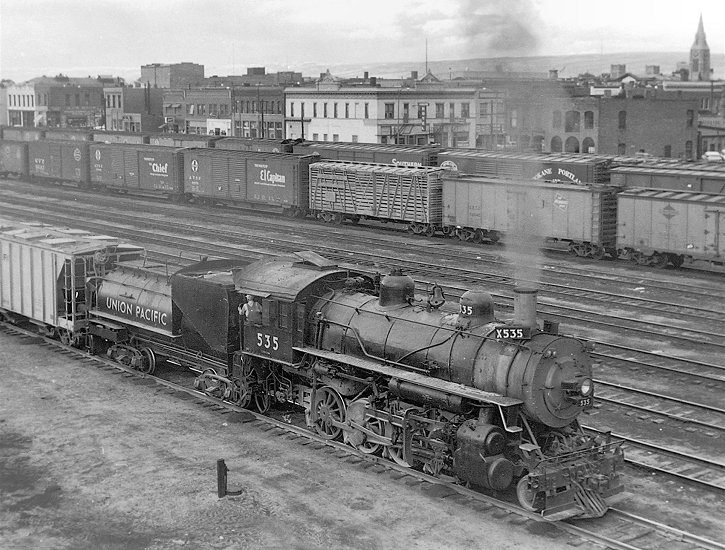
I was taking both Kodachrome slides and black-and-white photos on this trip, but since I had only one 35mm camera I had to do some fancy film changing. I would take a series of shots with one type of film, then note my exposure number and rewind till the wind-up knob stopped turning. Removing the film with leader still exposed, I would insert the other type of film. When the time came to switch back I would do the same with this cartridge, then reinsert the original cartridge and wind past the number of my last exposure. Crude, but it worked! Necessity, they say, is the mother of invention.
A number of American railroads operated simple articulated locomotives of the 4-6-6-4 wheel arrangement, but the Union Pacific had originated the type and given it its name, and owned about forty percent of them. The 3900-series Challengers of class 4664 were erected by American Locomotive Company during World War II in three groups. Strangely, the final group, class 4664-5 of 1944, was numbered 3930-3949 in a range preceding the earlier groups, class 4664-3 of 1942 (3950-3969) and class 4664-4 (3975-3999) of 1943. The locomotives of class 4664 had 69-inch drivers, sustained 280 pounds per square inch of boiler pressure, and had four 21x32-inch cylinders. They had a grate area of 132.2 square feet, 4640 square feet of evaporative heating surface, and 1740 square feet of superheater surface. They boasted a locomotive weight of up to 634,600 pounds and developed 97,350 ponds of tractive effort. Although other railroads used their 4-6-6-4s exclusively in freight service, the Union Pacific for a time employed some of its Challengers in passenger service in which they featured a special two-tone gray paint job.
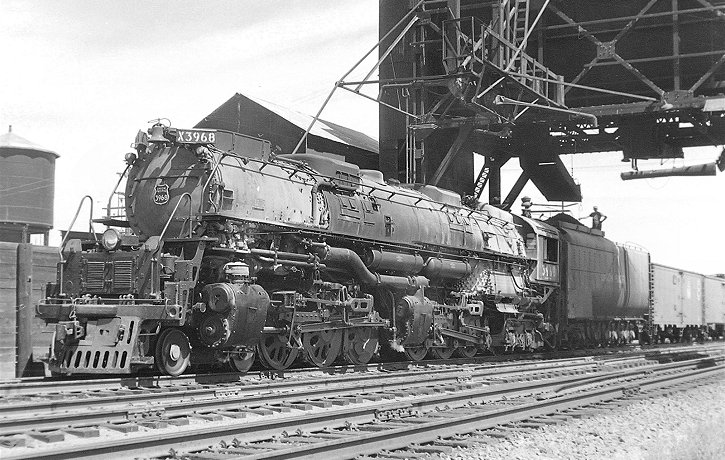
Leaving Laramie after our 1957 visit we worked our way towards Iowa along the Union Pacific main line, pausing for more photography as opportunity arose. At Pine Bluffs, Wyoming, on the Nebraska border, the Union Pacific maintained a fuel and water facility that towered over the main line. Here, Challenger No. 3968 of class 4664-3, erected in 1942, replenishes her tender before proceeding eastward on August 19. This photo appeared in issue 30 (summer 2011) of Modellbau, a German-language modeler magazine published by Eaglemoss Publications of the United Kingdom.
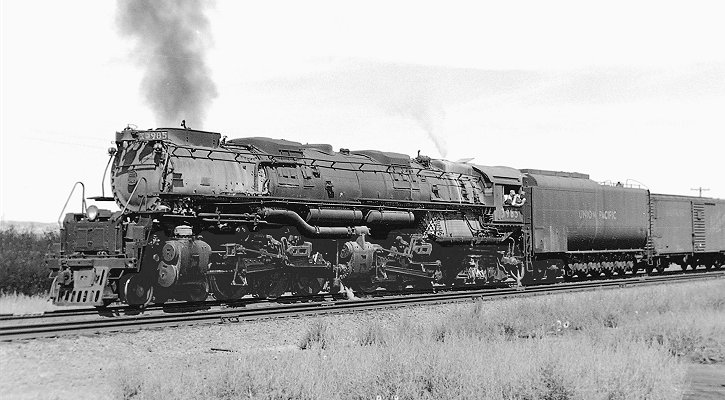
Who could have predicted that any steam locomotive we photographed in August 1957 would be operating again more than four decades later? But here is Challenger No. 3985, which enjoyed a long career in the Union Pacific steam program. I snapped her wheeling a westbound freight near Sidney, Nebraska on August 19. Reportedly No. 3985 was withdrawn from service that very month, so this could have been her last revenue run during the steam era.
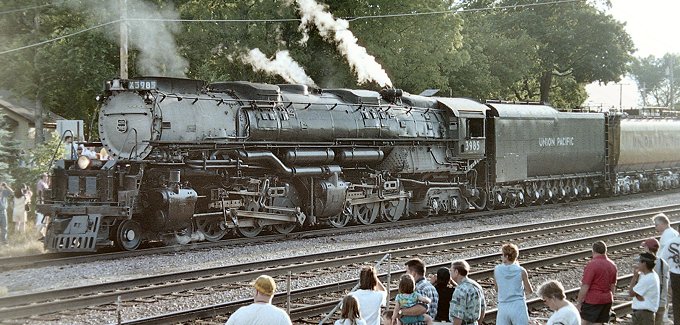
After being withdrawn from active service, No. 3985 was stored in the dark confines of the Cheyenne roundhouse for many years, shielded by local Union Pacific personnel from the prying eyes of railroad brass on the prowl for expendable assets. Finally she was put on display in Cheyenne, then reconditioned in 1981 for railfan excursion duty. Weighing in at over a million pounds including tender (and now equipped with two auxiliary water tanks), No. 3985 was for many years the largest operating steam locomotive in the world. In the color photo above she delights the fans and general public at West Chicago, Illinois during a June, 2002 visit to the Chicago area. With the restoration of Big Boy No. 4014 the Challenger was retired again, but in 2022 the Union Pacific donated it to the non-profit Railroading Heritage of Midwest America which plans to restore it to operation at the former Rock Island shops in Silvis, Illinois.
You can view additional photos of the Challengers in operation in 1957 in Richard Leonard's Big Boys & Challengers Gallery. For more information on the 4-6-6-4s, visit Wes Barris' Union Pacific Challengers page.
Our final exposure to Union Pacific main line steam on our August 1957 trip was at Grand Island, Nebraska. There, at the engine terminal, we found what had eluded us thus far: a good shot of one of the UP's famous Northern type locomotives. These 4-8-4s, while fully capable of handling freight traffic, had been built primarily for fast passenger service and were still performing that duty in 1957. No. 814, waiting here on a roundhouse lead track in a view by my brother David, belonged to class FEF-1, the first class of 4-8-4s erected for the Union Pacific by American Locomotive Company in 1937. These engines rolled on 77-inch drivers powered by 24½x32-inch cylinders, fed by 300 pounds of boiler pressure per square inch. They developed 63,500 pounds of tractive effort. As built they had 4597 square feet of evaporative heating surface, 1473 square feet of superheating surface, and a grate area of 100 square feet. In 1946 they were converted to burn oil.
No. 814 and her sisters originally had tenders with six-wheel trucks, but some were later equipped as shown here with the heavy-duty pedestal or "centipede" type tender favored by the Union Pacific for its newer steam power. (The original tenders were re-used with some of the UP's gas turbines.) I was informed by viewer John E. Bush that the older 800s that received the pedestal tenders got them from members of later classes which had been retired. No. 814 also sports the "elephant ears" or smoke deflectors applied to many modern steam engines. For a time around 1940, prior to application of the smoke deflectors, No. 814 also had an experimental skyline casing and smoke lifter.
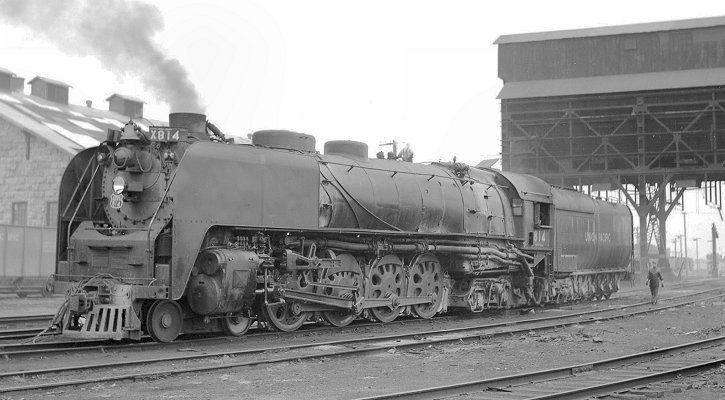
Mr. Bush comments further, "By the way, the engine is facing west, thus it's an 'in-bound' and is receiving certain service prior to placement in the house or simple turning. In some instances, the late power required so little work that they could be turned and sent the opposite direction, or placed back on their train to continue in the direction they'd been travelling upon arrival, without a visit to the house itself. I see the engine has an air connection made to the air line at the pilot, certainly for use in lubricating the rods with one of the big Alemite guns." Mr. Bush, a resident of Omaha, visited this location several years ago and reported that the limestone building behind, dating from about 1888, was still standing, although most other buildings and the coaling tower were gone.
The 800s were an outstanding class of locomotives, and were the prototype for an American Flyer S-gauge model train that our parents gave my brother and me one Christmas and which we enjoyed while growing up. Two additional classes, with larger drivers and higher boiler pressure, followed the FEF-1's; they were capable of 100-mile-per-hour speeds while pulling sixteen heavyweight Pullman cars. The famous No. 844, a member of class FEF-3 built in 1944 — the last group of steam locomotives ordered by the Union Pacific — was never removed from the active roster and still heads railfan specials. As for our No. 814, today she is displayed by the RailsWest Railroad Museum in Council Bluffs, Iowa. At an unknown date some years ago the Council Bluffs Chamber of Commerce published this postcard view of the displayed locomotive. Two other UP 4-8-4s remain, one of them supplying parts for No. 844.
The 3900-series Challengers of class 4664, with the pilot-mounted headlight, were not the only variety of 4-6-6-4s owned by the Union Pacific. Less celebrated were the original Challengers of class CSA, which ALCo delivered in 1936 and 1937. They had 22x32-inch cylinders, 69-inch drivers and 255 pounds of boiler pressure. Their grate area totaled 108 square feet; their exaporative heating surface was 5380 square feet and their superheating surface 1650 square feet. These locomotives exerted 97,300 pounds of tractive effort, and No, 3838's group in class CSA-2 weighed 584,950 pounds without tender. Originally numbered 3900-3939, the entire CSA class was renumbered to 3800-3839 in 1944.
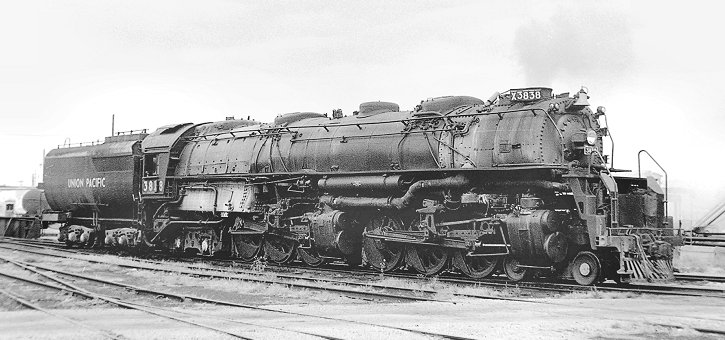
In my opinion these earlier Challengers more "classy" in appearance because of their center-mounted headlight. At the Grand Island terminal I took this photo of No. 3838. Her tender, mounted on standard six-wheel trucks, reveals her to be an oil-burner. A number of North American railroads used fuel oil (No. 5 or "Bunker C") as well as coal to fire their steam engines; the Union Pacific periodically converted groups of its Challengers from one fuel to the other and, in some cases, reconverted them to the original fuel. Challenger No. 3985 described above, originally a coal-burner, was converted to oil in 1990 so it could use diesel fuel, since coal is no longer readily available.
As we photographed these locomotives at Grand Island, our Union Pacific steam-hunting expedition was about to come to an end. My mother and sister had patiently endured hours of waiting in a hot car while my father, my brother and I had indulged our almost fanatic interest in tracking down examples of this fast-disappearing species. Rejoining them in our 1953 Plymouth, we headed east for less exotic activities — visiting more relatives in Iowa, then returning home to the beginning of the fall semester at Illinois Wesleyan University. But this had been a vacation we would never forget.