
Text and photo images
©2013 Richard Leonard.


|
After we had moved to southeastern Michigan I became familiar with vestibule-cabbed Wabash 4-8-4s and 4-8-2s spiriting freight trains through rural countryside in Lenawee County. One day Dad drove us boys to Delta, Ohio, on the NYC main line, where we parked by the station and watched the parade of speedy east-west limiteds on this stretch of tangent track, 68.5 miles west of Toledo without a curve. There is nothing in my memory to equal the sight and sound of those onrushing Hudsons and Mohawks — whistle wailing, rods flailing, smoke trailing low over the cars.
Yes, I wish I had a photographic record of all those memories. Dad, for some reason, was not an avid photographer of trains. But, as I reached my teen years in the early 1950s, I became acutely aware that we were living in the twilight of steam power — and steam locomotives were my primary railroad interest. I borrowed the old Kodak Hawkeye folding cartridge camera that Dad had bought for $3.00 during the Depression, The old camera was limited to a shutter speed of 1/60th of a second, too slow to do much with action shots. Worse, it had a light leak in the bellows that caused me no end of grief — important shots were often ruined by streaks of white in critical places. But it was all I had with which to record the steam action of various Michigan lines, some Canadian lines, and then the railroads of central Illinois where we moved in 1954. Finally, around 1957, I acquired my first 35mm camera and was able to photograph some late steam activity in the Midwest and West in both black-and-white film and color transparencies. With the end of the steam era in revenue service, by 1960, my railfan activities took a back seat to other interests. Diesels did not interest me much, though a few that I photographed over the years turn out to be collectors' items today (see my Vintage Diesel Miscellany). I attended Boston University for my theological degree and for my Ph.D. in Biblical Studies, contemplating a career in academia and the ministry. Eventually, however, I found myself without church or college employment and took a temporary job with Rand McNally in the Chicago area. This "temporary" work turned into a twenty-year assignment with that company as a transportation data analyst. During that time I spent a few years managing a team assembling data for "Railroad MileMaker," a computerized rail routing and mileage product which Rand McNally subsequently leased off to a firm better positioned in the rail industry. That was the only employment I ever had that was related to railroads, but my life-long hobby interest in rail transportation was instrumental in what I and my group of analysts were able to do — the product actually worked, and impressed officials of several railroads to whom we gave demonstrations. I took early retirement from Rand McNally in 2001.
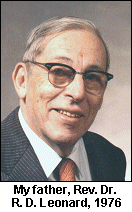
My brother, Rev. David V. Leonard, late of of Binghamton, New York, continued to pursue his train-photography efforts into the diesel era and let me put some of his work in this Rail Archive. As for Dad, who passed on in 1976, after retirement from the history department of Illinois Wesleyan University he became founding president of the Central Illinois Railroad Club, and in 1966 he was one of three who signed the incorporation papers for what became the Monticello Railway Museum. I still chase trains once in a while, although opportunities for steam photography in our area are rare. My wife and I live in Hamilton, Illinois, where we hear the diesel horns from the busy BNSF "K Line" across the Mississippi in Keokuk, Iowa. Pioneer Railcorp's Keokuk Junction Railway passes through Hamilton, and for more than a decade I owned a few shares of Pioneer Railcorp stock until a group of investors bought out the company. I'm also a volunteer in the effort to restore the historic Keokuk Union Depot, and am the builder of the Depot's web site and a director of the Keokuk Union Depot Foundation. But as far as railroad activity is concerned, there is little today to captivate me as did my steam-hunting activities of the 1950s, of which this Steam Locomotive Archive is the record. |

|
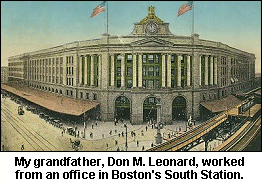 The world of railroading has interested me from my childhood. My younger brother and I inherited our love for trains from our father, Rev. Dr. R. D. Leonard, a Methodist minister and college professor. While other dads took their boys camping or to baseball games or museums, our dad took us on train-watching expeditions — to roundhouses, yards, shops, passenger stations or just trackside along busy lines. Most of these early trips involved Dad's favorite railroad, the New York Central. Our grandfather, Don M. Leonard, had been an official of the Boston & Albany, part of the New York Central System, in the early 1900s.
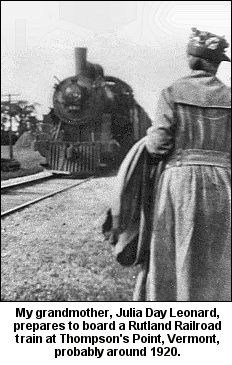 So railroads were our "thing" while growing up; we played, dreamed and talked trains. Sometimes, during church services while Dad was preaching, my brother and I would amuse ourselves by drawing pictures of steam engines with paper and pencils Mother thoughtfully provided. Walking home from junior high school in Adrian, Michigan, I would pause to watch the switching movements of the Detroit, Toledo & Ironton local freight on the Tecumseh branch, headed by a spic-and-span
  I wish I had been able to record on film some early, memorable scenes of railroad activity during the steam era. Among my first memories are triple-heading Canadian Pacific and Boston & Maine power on the joint line north of St. Johnsbury, Vermont. After a move to Michigan I witnessed New York Central Consolidations with idler flat cars switching the railroad ferry at Mackinaw City. We happened to be there on V-J Day, August 14, 1945, and heard all the locomotives in the joint NYC-Pennsylvania roundhouse blowing their whistles in celebration. A visit to the NYC's Jackson, Michigan shops arranged by an engineer friend was the occasion for my first ride in a steam locomotive, H-10b
 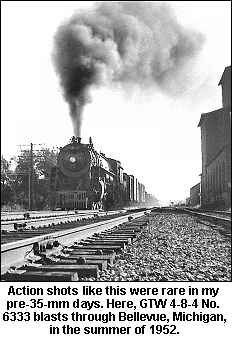 managed to scrounge a few rolls of No. 116 film, and set out for trackside in the little Michigan town of Bellevue on the Grand Trunk Western's Chicago-to-Port Huron main line where my father was then serving as the Methodist minister.
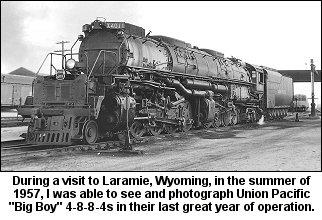 Meanwhile, the Internet developed. I had become familiar with computers at Rand McNally and was using them at home. In 1998 I decided to bring my railroad photography efforts out of their basement storage cartons and put them on a web site for others to enjoy. This was the origin of my Steam Locomotive Archive, still the flagship section of my now greatly expanded Richard Leonard's Rail Archive. The site is still growing, as I acquire new material from time to time.