
E-Mail Us:
railarchive@mail.com
Text and photo images
©2013 Richard Leonard.


Steam locomotives resisted the onset of dieseldom a bit longer in Canada than on most railroads south of the border, and this was also true for Canadian National Railways' operating unit in the Great Lakes states, the Grand Trunk Western. Until the mid-1950s the GTW's passenger service was still entirely steam-operated, with the exception of the Detroit-Port Huron motor train. Passenger power consisted of 4-8-4s, 4-8-2s and 4-6-2s and even a 2-8-0 in mixed train service on the Greenville branch; in the last days of steam some 2-8-2s were used in Detroit suburban service. To see a list of Grand Trunk Western locomotives as of 1938-1942, most of which were still active in the early 1950s, visit our GTW Roster. In addition, we are making available a copy of the GTW Passenger Timetable, September 30, 1951 in PDF format. For more GTW and CNR steam images taken by my late brother, visit David Leonard's CNR-GTW Steam Gallery, 1958. Additional views from both of us appear in our Random Steam Collection.
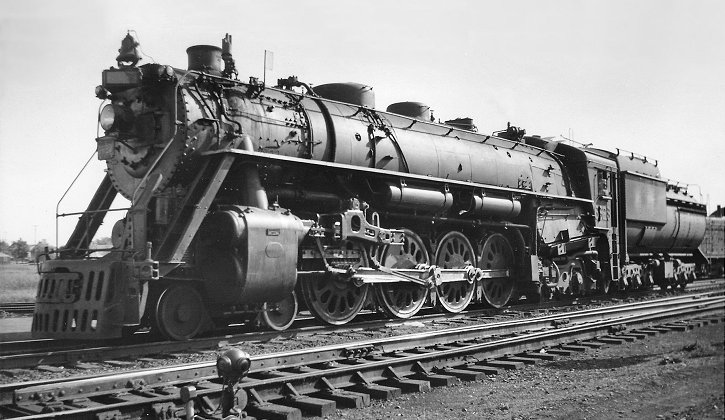
The GTW's class U-3-b 4-8-4s were built by American Locomotive Company in 1942-1943 for both freight and passenger service, and capably handled such trains as the Maple Leaf, the Inter-City Limited, and the International Limited in addition to main line freights. 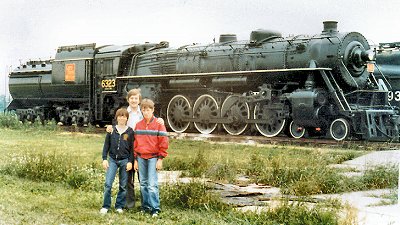 I photographed No. 6323 at Durand, Michigan, in May, 1954, while it was temporarily separated from the Maple Leaf so diesel switcher 7904 (visible behind 6323's tender) could switch a car for the Detroit connection. With a locomotive weight of 403,000 pounds and a combined engine-and-tender length of 96 feet, the U-3-b class was still one of the smaller types of 4-8-4s used on the North American railway system.
These engines had 73-inch drivers, 26x30-inch cylinders, and a boiler pressure of 250 pounds per square inch, producing a tractive effort of 59,034 pounds. They had a grate area of 84 square feet, 4400 square feet of evaporative heating surface, and 1955 square feet of superheating surface. They ended their days in Detroit suburban passenger service, and can be seen in this role on the Herron video/DVD Glory Machines of the Grand Trunk Western. No. 6323 is said to be that last steam locomotive used in main line passenger service in the U.S., and made her last run under GTW ownership on September 20, 1961. Minus boiler jacketing and various parts, she survives at the Illinois Railway Museum in Union, Illinois, where I was photographed in front of her with my son Matthew and a friend in June, 1982. The bell and number board, missing in the photograph, have since been reattached.
Rich Brzycki sent me a photo he rediscovered of No. 6323 at speed on the main line with a passenger train, probably the Inter-City Limited judging by the sun angle. It was taken from a car pacing on a parallel highway, evidently by Tom Miller of Toledo, Ohio. Gary Thompson provided a photo by William Rosenberg of No. 6323, garishly decorated with white front steps, on a 1961 Labor Day fan trip at South Bend, Indiana.
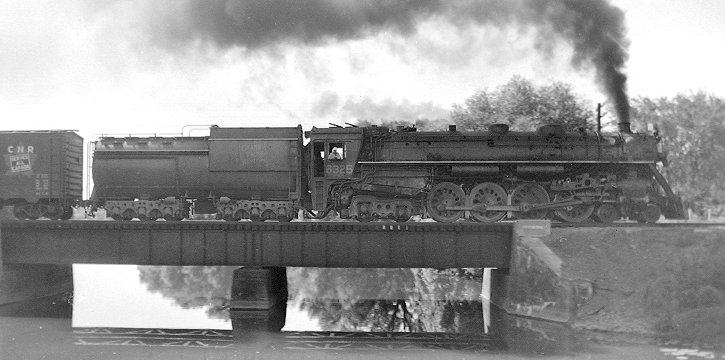
Sister locomotive No. 6325 also remains and was restored to service by the late Jerry Jacobson and the Ohio Central Railroad. With the sale of the Ohio Central to the Genessee & Wyoming, Mr. Jacobson's entire steam collection was transferred to the Age of Steam Roundhouse near Sugarcreek, Ohio. Above, No. 6325 rests on the bridge over the Battle Creek River in the summer of 1952, waiting for the highball to proceed westward. The engineer, leaning on the window sill, regards the photographer (me) on the M-78 highway bridge with some amusement.
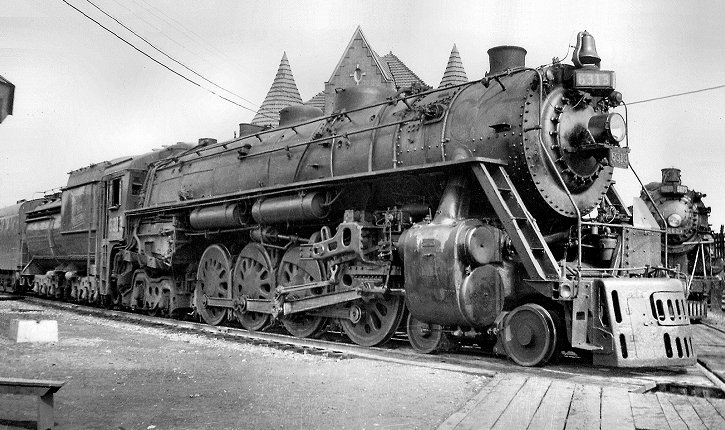
 The distinctive turreted rooftop of the historic Durand depot pokes skyward behind U-3-b 4-8-4 No. 6313, above, as she pauses with the mid-afternoon Inter-City Limited in the summer of 1953. Peering over her shoulder is K-4-a Pacific No. 5629, famous for her steam excursions in the diesel era (see below). She heads train No. 21 bound for Muskegon. This photo appears in I. E. Quastler's book Where the Rails Cross: A Railroad History of Durand, Michigan, published in September 2005. No. 6313, along with most members of the U-3-b class, was scrapped in 1960.
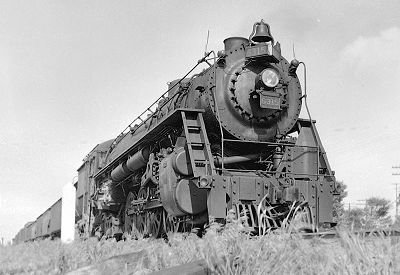
At left is a dramatic low-angle shot of 4-8-4 No. 6315, stopping briefly with her freight train on the main line at Bellevue, Michigan in the summer of 1953. This view highlights the slightly raised headlight of some members of the U-3-b class, reportedly due to their having been shopped when on loan to the Canadian National which preferred the higher position. Others, such as the surviving No. 6325, had the headlight centered on the smokebox front. Notice also that this locomotive, in common with some other members of the U-3-b class, had the boiler tube "cowcatcher" pilot whereas most were fitted with the cast steel pilot shown on Nos. 6323 and 6313 above and 6328 below. The low photo angle was mandated by the location, as the roadbed was on a fill and there was no way to photograph the locomotive from track level.
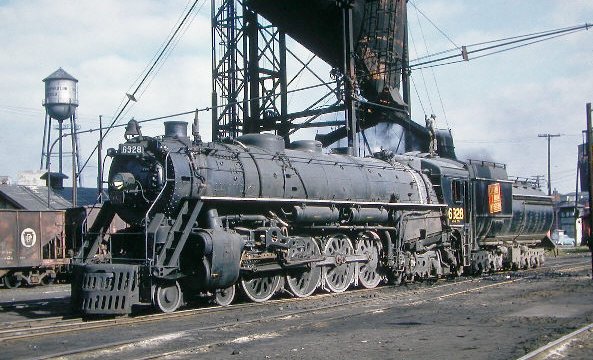
After our family had moved to Bloomington, Illinois, my brother David took my 35mm camera on a steam-hunting expedition to Michigan and Ontario. On September 2, 1958 he found 4-8-4 No. 6328 taking on a fresh load of coal at the GTW's Milwaukee Junction terminal in Detroit, and snapped this transparency. Members of the U-3-b class had only two more years to run in this Detroit suburban service, their final assignment. No. 6328 met the torch in Chicago in 1960.
Streamlining of steam engines for passenger service enjoyed a brief vogue in North America after diesel streamliners were introduced in the 1930s. Although the 4-8-4 was a popular dual-service locomotive, only a few railroads applied streamlining or semi-streamlining to this wheel arrangement. The Southern Pacific's Daylights and the Norfolk & Western's Class J series were outstanding examples.
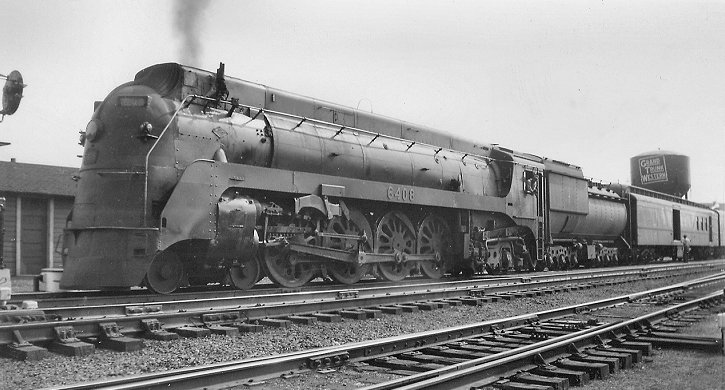
 Proud queens of Grand Trunk Western's steam passenger fleet were the six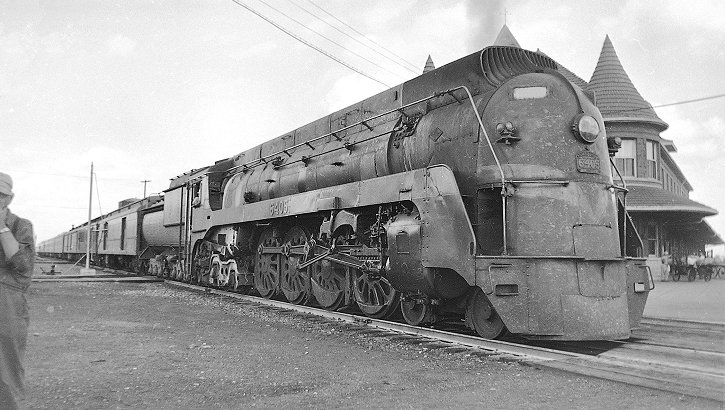
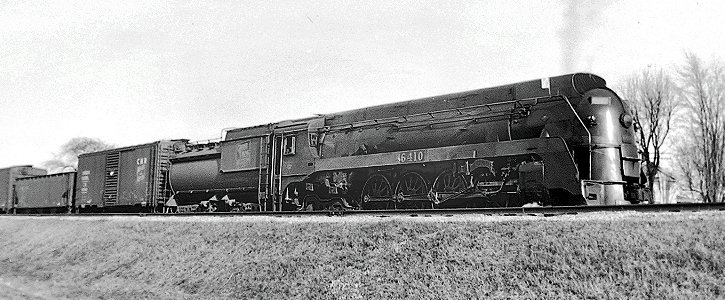
Occasionally the 6400s were seen on freight trains, especially on break-in runs after overhauling at the Battle Creek shops. In the view below we see No. 6410 in this role at Bellevue, Michigan late in 1952. The U-4-b class had a grate area of 73.7 square feet; they had 3860 square feet of evaporative heating surface, and their superheating surface totaled 1530 square feet.
In the 1950s, the Grand Trunk Western operated five 4-8-2s in class U-1-c, Nos. 6037-6041. When new, these locomotives had been assigned to passenger service on the Chicago-Port Huron main line, but by the time my family was living in Michigan their main territory was the Detroit-Muskegon line. As a result I never saw them in operation, though I photographed No. 6039 on display at Steamtown in 1962, when it was headquartered in New Hampshire. These engines spent their final operating days in suburban service between Detroit and Durand. My brother, David Leonard, photographed No. 6040 in Detroit on September 2, 1958, as shown below.
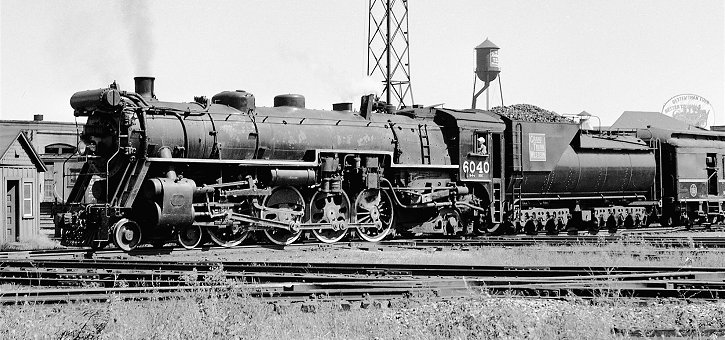
Class U-1-c was delivered by Baldwin Locomotive Works in 1925. This group had 26x30-inch cylinders, a driver diameter of 73 inches, and a boiler pressure of 210 pounds per square inch. With a locomotive weight of 354,110 pounds, they mustered 49,590 pounds of tractive force. The GTW gradually equipped these locomotives with disc drivers. Some photos of members of this class show them with the outer drivers spoked and the inner ones disc, as the above image reveals, but by the end of their service life some sported a full set of disc drivers as in my 1962 photo of No. 6039, now at Steamtown National Historic Site in Scranton, Pennsylvania. Notice also that the U-1-c class, in common with most of their Canadian National sisters, had the "Indirect" or "reverse" configuration of the Walschaerts valve gear, in which the eccentric crank angles toward the rear when the driving rods are in the bottom quarter.
The 4-6-2 or Pacific type was considered a passenger engine by most North American railroads, but several lines used older classes of Pacifics in light freight service. Grand Trunk Western was one of them (others included Illinois Central, Atlantic Coast Line and Canadian Pacific). Normally the local freight through Bellevue, Michigan, was headed by a Consolidation. But on this summer day in 1951 it was Pacific 5030, on a break-in run after repairs at the Battle Creek shops, which did the honors. My train-watching that day netted me a bonus: a ride in the cab at the invitation of an engineman, and the photo at left, which is the oldest photo taken by me in this Archive.
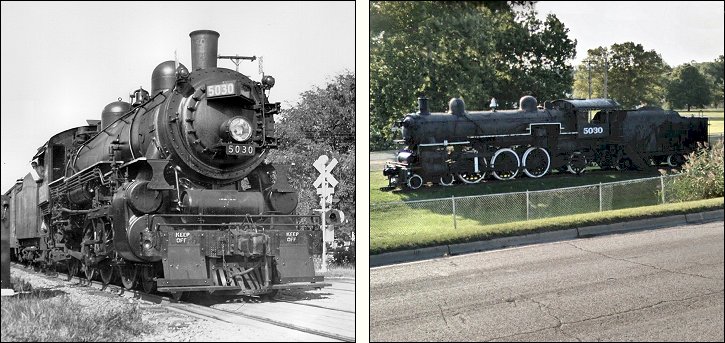
Nos. 5030-5048 were built by Baldwin Locomotive Works in 1912 for GTW's predecessor, the Grand Trunk Railway, as Nos. 100-118; No. 5030 was GTR's No. 100. Class J-3-a had 69-inch drivers, a boiler pressure of 185 pounds per square inch, and cylinder dimensions of 23x28 inches. These engines weighed 224,100 pounds and exerted a modest (by later standards) 33,756 pounds of tractive effort. They had a grate area of 50.6 square feet, an evaporative heating surface of 2826 square feet, and a superheating surface of 592 square feet.
No. 5030 had been involved in a notorious train wreck, that of the "Knights Templar Special" on June 5, 1923. Due to poor ballast conditions the train jumped the tracks a mile west of Durand, Michigan. Five people lost their lives in the accident. No. 5030 was captured on movie film by Jerry Carson and may be seen in the Green Frog video Steam in the 50's. She has been displayed at R. A. Greene Park in Jackson, Michigan, as seen in the view on the right adapted from Google Maps, August 2017. A YouTube user has also posted this video of No. 5030 in the park taken in August 2015. In January 2021 the locomotive was sold to the Colebrookdale Railroad, a Pennsylvania tourist line, for eventual restoration to operation. My photo (above, left) was used in their online promotional poster. It also appears on the back cover of the Spring 2022 issue of The Semaphore, magazine of the Grand Trunk Western Historical Society.
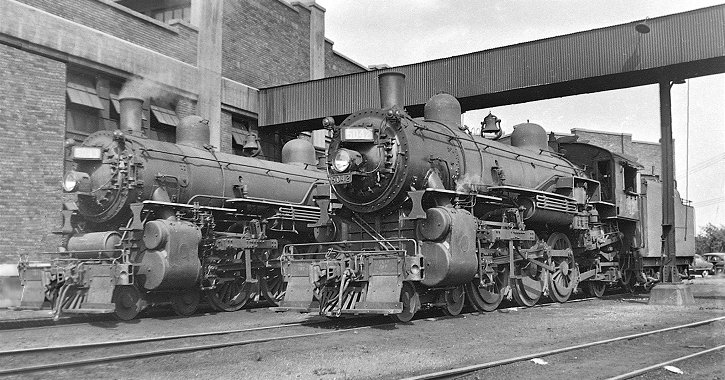
The Grand Trunk Western continued to use steam engines in commuter service and other local and branch line assignments in the Detroit area through the late 1950s, with a few locomotives serving until 1961. In the summer of 1953 we visited the Grand Trunk Western engine terminal in Pontiac, Michigan. Here we found J-3-a classmates Nos. 5043 and 5042 resting near the roundhouse.
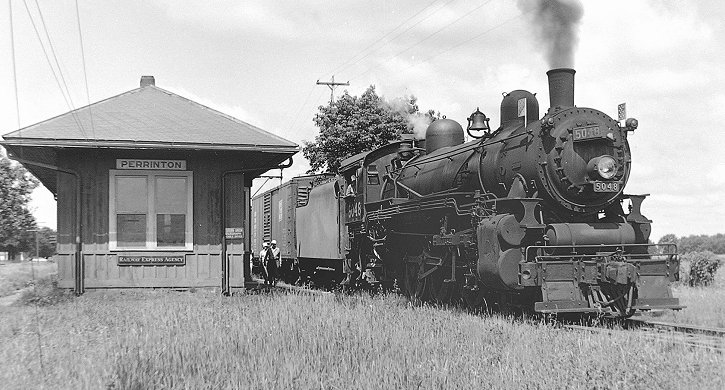
During that same summer my father was transitioning between serving as Methodist minister in Bellevue, Michigan and teaching at the Detroit Institute of Technology. To span the gap between these assignments he filled in as minister of the Methodist Church in Middleton, Michigan, on the Grand Trunk Western's Greenville branch. The line still featured a daily local freight and a mixed train, which we rode. Power consisted of the 5000 series Pacifics and 2600-series Consolidations. Above, in a photo that also appears in Grand Trunk Western Railroad: An Illustrated History by I. E. Quastler, we see 4-6-2 No. 5048 with the local freight at the depot in nearby Perrinton.
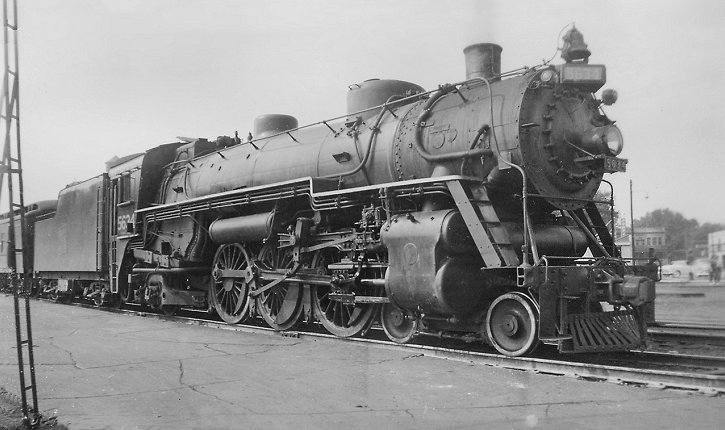
Making a stop at Durand, Michigan, with train No. 56 from Muskegon to Detroit is 4-6-2 No. 5634. She was the last of three K-4-b class Pacifics built for the Grand Trunk Western by Baldwin Locomotive Works in 1929. They featured enclosed or vestibule cabs similar to those on GTW's 4-8-4s and 4-8-2s, and also introduced the exhaust steam injector in place of the feedwater heater of the K-4-a class. This photo was taken in the summer of 1953.
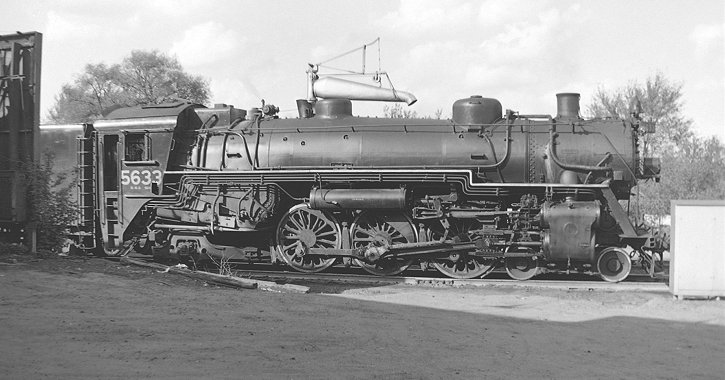
This broadside view of another example of the K-4-b class, No. 5633, displays the web-spoke drivers that seem to have been applied only to this member of the trio. The photo was taken during a station stop at Pontiac, Michigan, in May, 1954. All these Pacifics had 73-inch drivers and 25x28-inch cylinders. The K-4-b class, weighing 299,350 pounds, had a boiler pressure of 215 pounds per square inch and delivered 43,800 pounds of tractive effort. No. 5632 of this class is preserved at Durand, Michigan.
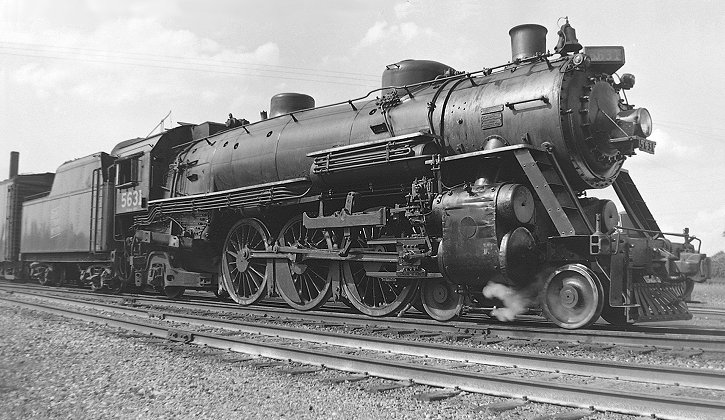
Class K-4-b had been preceded in 1924 by the five locomotives in class K-4-a from American Locomotive Company, which lacked the vestibule cab. Here we see No. 5631 at Durand in the summer of 1953, handling the same train as No. 5634 above. The dimensions of the K-4-a class were similar to those of the later K-4bs, except that their boiler pressure was only 200 pounds. They weighed 285,500 pounds and developed 40,750 pounds of tractive force. The K-4 Pacifics were a variation of the USRA light Pacific design; they had 67 square feet of grate area, an evaporative heating surface of 3340 square feet, and 795 square feet of superheating surface.
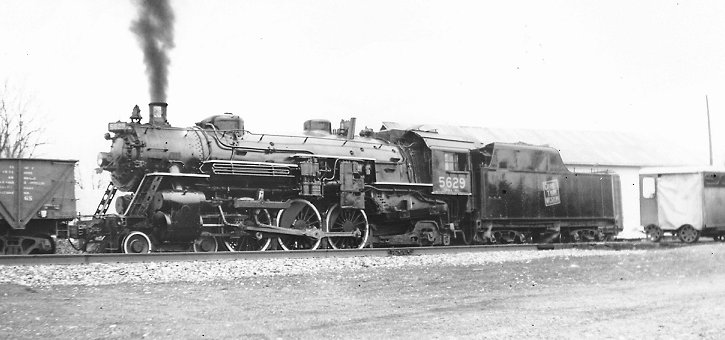
The famous K-4-a No. 5629 enjoyed a career as a privately-owned steam excursion locomotive in the 1960s and early 1970s, refitted with the headlight from Illinois Central 2-8-4 8049 (the original Lima "super-power" demonstrator) and a larger tender from Soo Line 4-8-2 4013. Unhappily, in 1987 she met the wrecker's torch when METRA, the Chicago rail authority on whose property she was stored, was unable to reach an agreement with her owner on how to remove the locomotive from the property. I took the above photo of No. 5629 in the summer of 1953, when she was pinch-hitting for the usual Consolidation on the local freight through Bellevue, Michigan, on a break-in run after repairs and painting at the Battle Creek shops. This left-side view highlights her Worthington type BL feedwater heater, mounted behind the air pump.
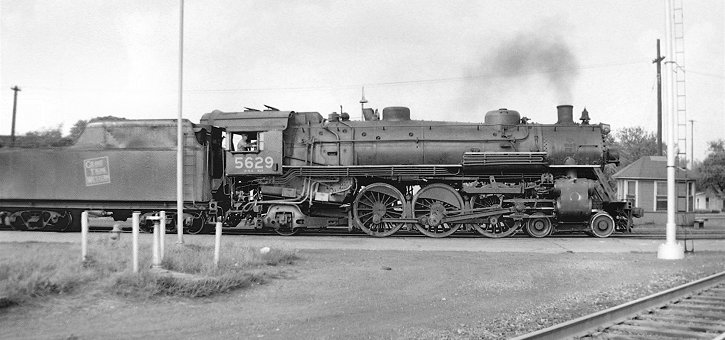
In another view of No. 5629 we find her at the Durand diamonds during the summer of 1954, waiting to proceed south into the depot with No. 56, her Muskegon-Detroit train. The Herron video/DVD Glory Machines of the Grand Trunk Western features a helicopter chase of the modified No. 5629 in excursion service out of Chicago.
The Grand Trunk Western in the early 1950s had EMD road freight diesels (modified F-3s, unofficially a called F-5s), and some EMD switchers. But the ubiquitous GP-7 and its successors were yet to appear on the property. As a result, local freight and branch line duties were still performed by the GTW's ageing stable of lighter steam power. I spent many an hour watching Consolidations, and sometimes Pacifics, switch the handful of industries that lined the track near the depot, a few blocks south of our home in Bellevue, Michigan. Bellevue was still served by a part-time operator, and although passenger trains no longer stopped at our village of 1,000 between Battle Creek and Charlotte, there was some freight business.
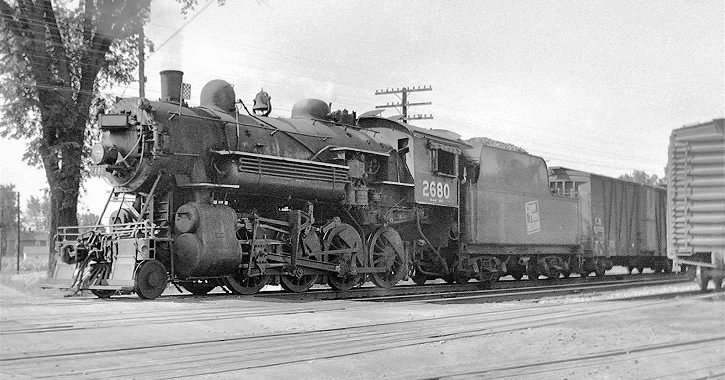
One of my earlier shots, from the summer of 1952, features Consolidation No. 2680, the "regular" on the local freight at that time. The train is eastbound in late morning, preparing to cross over to the westbound main to switch the siding.
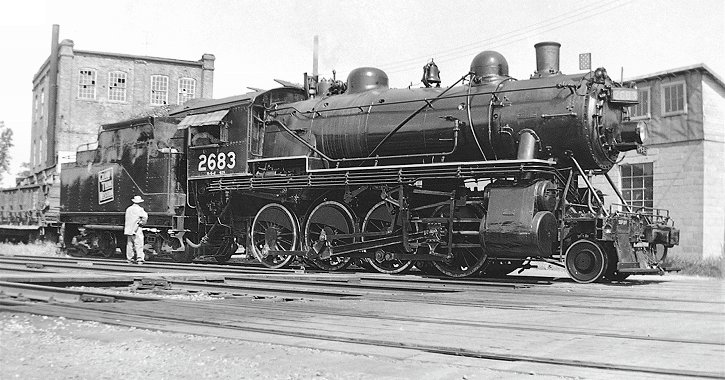
This portrait of 2-8-0 No. 2683 at Bellevue, from the summer of 1953, reveals the careful maintenance the Grand Trunk Western applied to even its older locomotives. She sports a shiny paint job recently applied at the Battle Creek shops, including white tires and the tilted GTW herald on the tender.
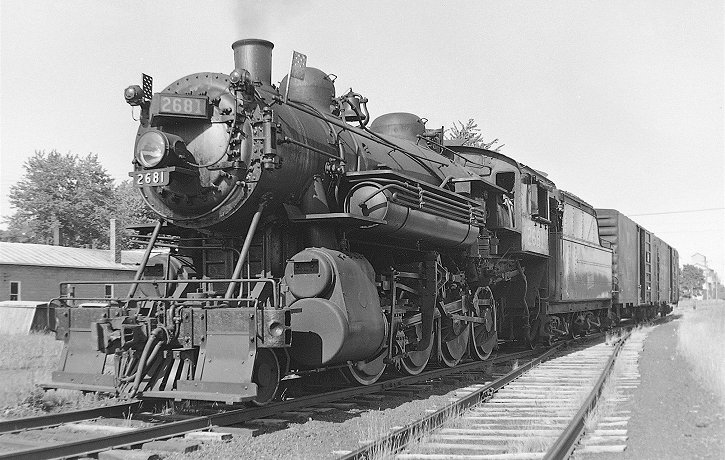
Above, sister No. 2681 poses in Middleton, Michigan, on the Greenville branch, in June 1954. These Consolidations were members of class N-4, which had several subclasses; all were built between 1906 and 1911 for the Grand Trunk Railway. With 63-inch drivers, they had 23x32-inch cylinders and carried a boiler pressure of 180 pounds per square inch. They weighed about 211,200 pounds and were rated at 40,000 pounds of tractive effort. The locomotives shown here belonged to class N-4-d. According to Larry D. Bell, a former GTW employee, they were built in 1911 by the Brooks works of the American Locomotive Company as cross-compound locomotives, with steam from the high-pressure cylinder on the fireman's side being reused in the low-pressure cylinder on the engineer's side. They were converted to a "simple" locomotive (both cylinders use fresh steam) around 1926. I. E. Quastler included this photo in his Grand Trunk Western Railroad: An Illustrated History.
As with many major railroads of North America, the 2-8-2 or Mikado type locomotive had been the Grand Trunk Western's principal main line freight power until the appearance of dual-service 4-8-4s beginning in the late 1920s. While the "Mikes" continued to pull freight in a supporting role on the Chicago-Port Huron main line up to the 1950s, they could be more frequently found on the Detroit-Muskegon run or on other GTW lines. In the late days of steam they drew a variety of assignments, even serving in Detroit suburban service — an unusual assignment for a locomotive which in North America was used almost exclusively to haul freight.
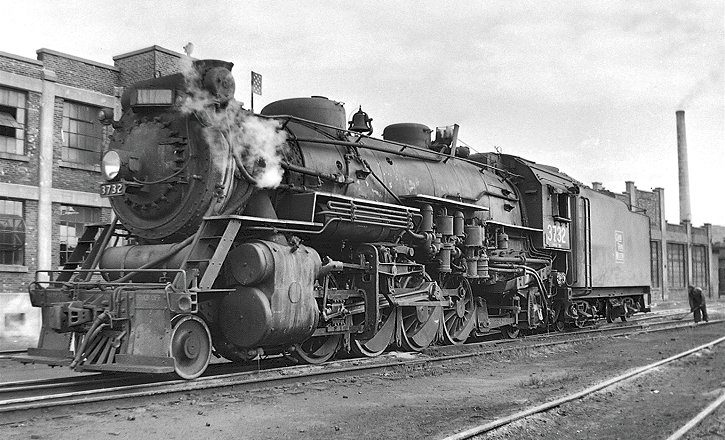
I snapped the above photo of No. 3732 at the engine terminal in Battle Creek in August, 1956. She belonged to class S-3-a and was erected by American Locomotive's Schenectady works in 1918. These engines weighed 290,000 pounds and had the 63-inch drivers common to all Canadian National and Grand Trunk 2-8-2s. Their 26x30-inch cylinders, supplied by 200 pounds per square inch of boiler pressure, produced a tractive effort of 54,724 pounds. No. 3732 was renumbered to 4068 in June 1956 to make room for diesels.
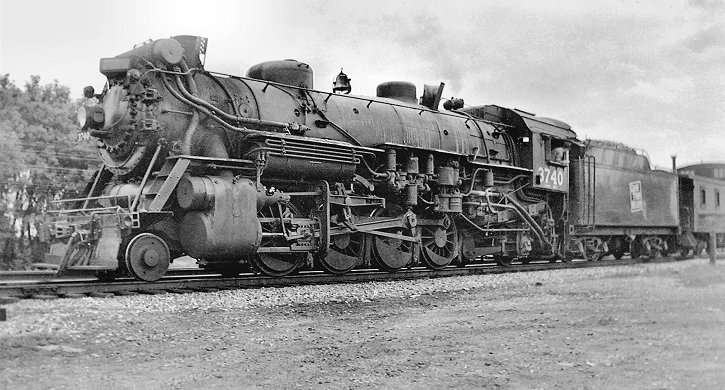
Probably the lowliest assignment given to these engines was work train service, almost always a task relegated to obsolete or surplus power even today. Above, at Bellevue, Michigan in the summer of 1952, we see 2-8-2 No. 3740 of class S-3-b in this capacity, trailed by a caboose and perhaps other cars used by a track work crew. No. 3740 was built by Schenectady in 1923, and was listed as being renumbered to 4076 in June 1956.
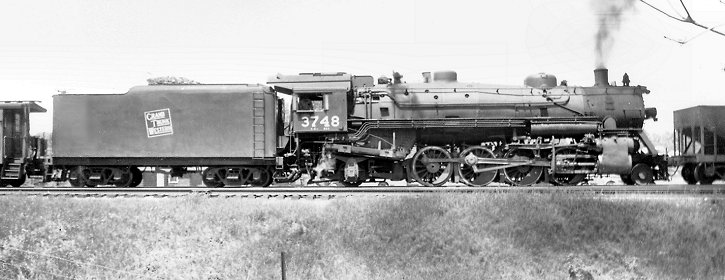
I have a train order copied by station operator Hart at Bellevue, dated June 26, 1953, that reads: "Eastward track single track between Nichols yd [at Battle Creek] & Bellevue until 5:00 pm. Work Ex 50196 and 3748 working between Nichols yd & Olivet." (No. 50196 was a self-propelled Burro crane used in track work.) Above we see No. 3748, mentioned in the train order, in its work train duty. A member of class S-3-c outshopped by American Locomotive in 1924, she was assigned No. 4083 in the 1956 renumbering. No. 3748 appears briefly in the Herron video/DVD Glory Machines of the Grand Trunk Western.
Mikado No. 3734 was a member of class S-3-a, built by American Locomotive Company in Schenectady to USRA light Mikado specifications similar to those of Nos. 3732, 3740 and 3748 above. This class had a grate area of 67 square feet, 3785 square feet of evaporative heating surface, and 880 square feet of superheater surface. I photographed No. 3734 heading a westbound local freight in my village of Bellevue, Michigan, in the autumn of 1952. In her tow is one of the K-4-b Pacifics (identifiable by the vestibule cab) evidently destined for shopping at Battle Creek.
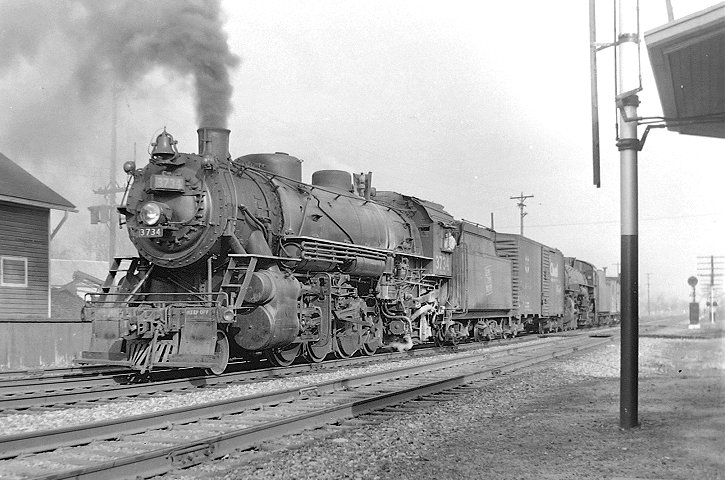
In the GTW's the June 1956 renumbering, 2-8-2 No. 3734 became No. 4070 and may have been the last steam locomotive to haul freight on the Grand Trunk Western. Like Pacific 5629, this engine received a larger tender and was featured in fan trip service at the head of a number of railfan specials in the 1960s and 1970s. No. 4070 was then acquired by the Midwest Railway Preservation Society for use on its Cuyahoga Valley Line. Out of service since 1990, she is undergoing restoration in Cleveland.
|
In the summer of 1953, as mentioned above, a crane was working on the westbound track near Bellevue, and trains were being diverted to the eastbound main between Bellevue and Nichols Yard in Battle Creek. Here is a copy of a train order issued by the Battle Creek dispatcher on June 26, 1953, to the engineer of the work crane, No. 50196, and the Bellevue operator, V. R. Hart. It reads, "Eastward track will be used as Single track Between facing point Crossover Bellevue and regular Crossover located at Switchtenders Shanty East End Nichols Yard Seven Oclock 700 am until Five O'clock 500 pm. Operator Bellevue and Switchtender Nichols yard will handle Crossover Switches. do not Exceed Fifteen 15 Miles per hour entering and leaving single track — V.R.H." In the photo below, 4-8-4 No. 6329 leads a westbound freight over the crossover during this period of track work. 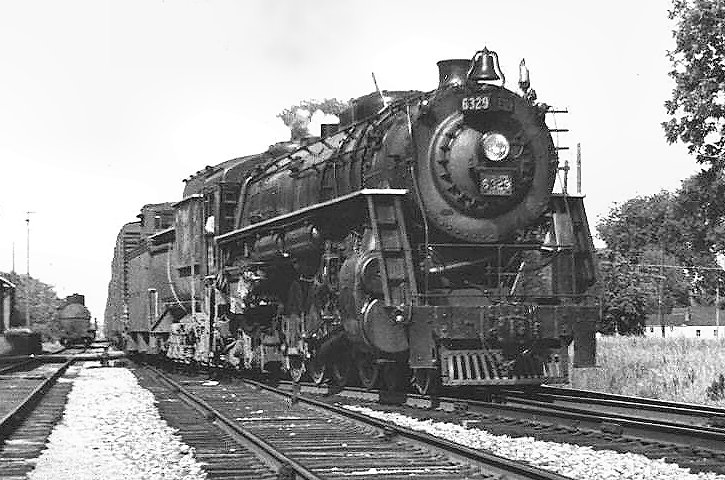
In this view, the strap pilot applied to several of the U-3-b class is apparent. I snapped several photos of No. 6329 during the summer of 1953, including the one below in which the 4-8-4 pauses just east of Bellevue with an eastbound movement. This engine may be seen at the head of a fast freight in Chicago's south side on John Szwajkart's video The Chicago Collection. She was sent to the scrapyard in 1959. 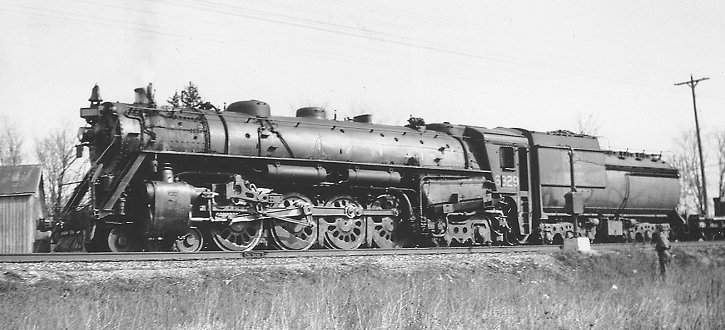
|
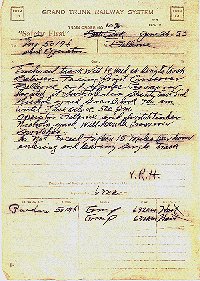 As previously noted, in the early 1950s my little town of Bellevue, Michigan still boasted an operator who manned the small Grand Trunk Western depot. This was long before the days of computerized and radio-controlled train dispatching from half a continent away, and the ancient telegraph still ticked busily in the operator's office. There was a crossover at Bellevue from the westbound to the eastbound main, and right-of-way maintenance or other conditions might require trains to switch from one track to the other. The operator had to copy, and hand up to the crews, any train orders issued by the dispatcher in Battle Creek that governed movements over the crossover. (Train orders were sometimes called "flimsies" because of the thin paper used in making multiple carbon copies.) In addition he would regularly report to the dispatcher the passing of all trains past the Bellevue depot on this busy stretch of railroad.
Below is a broadside shot of 0-8-0 switcher No. 8380 in the yards at Durand, Michigan during the summer of 1953. (It was used in Quastler's Where the Rails Cross, mentioned above.) No. 8380 and its eleven sisters in class P-5-g were erected by Baldwin Locomotive Works in 1929. With cylinder dimensions of 22x28 inches, they sustained a boiler pressure of 220 pounds per square inch. They had 51-inch diameter driving wheels, weighed 215,150 pounds, and exerted 49,691 pounds of tractive effort.
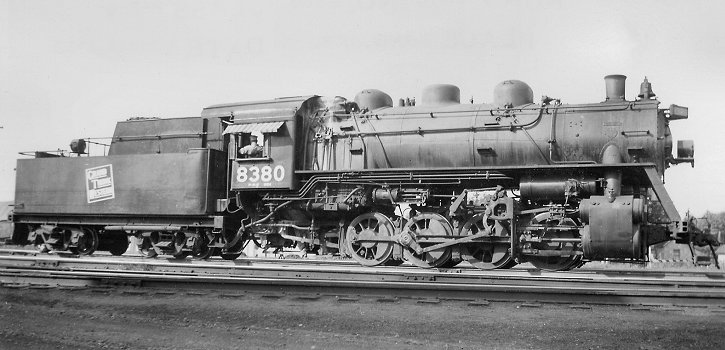
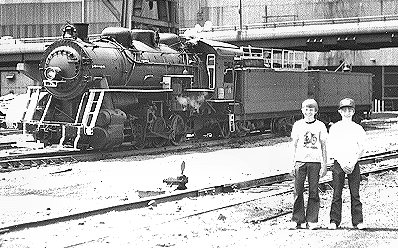 At the end of steam operations, the GTW sent many of its retired locomotives to Northwestern Steel & Wire in Sterling, Illinois, for scrapping. Instead of cutting them up, the scrappers converted a number of these GTW 0-8-0s to oil burners, added auxiliary water tenders and kept them around to switch the plant until 1980. I saw them operating there a few times, and photographed my sons Peter and Paul posing with Northwestern Steel & Wire's No. 76 (Former GTW 8376) in May, 1977. No. 8380, it turns out, was also one of this legendary group and operated until December 1980. In 1999, 46 years after I photographed her at Durand, I posed in front of No. 8380 at the Illinois Railway Museum. As for No. 76 (8376) today it is at the Amboy Depot Museum in Amboy, Illinois.
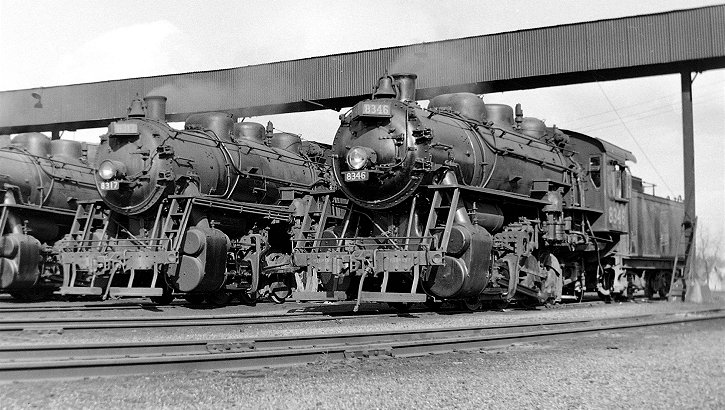
Below we see two more examples of the Grand Trunk Western's fleet of eight-wheeled switchers. Nos. 8317 and 8346 rest next to the Pontiac, Michigan roundhouse in the summer of 1953, awaiting their return to switching duties. No. 8317, an ALCo product of 1924, belonged to class P-5-b; with 200 pounds of boiler pressure, she weighed 211,000 pounds and mustered 45,000 pounds of tractive force. No. 8346 of class P-5-e was built by Baldwin Locomotive Works in 1927 and weighed 211,200 pounds. In other respects these engines had specifications similar to No. 8380, above. Both of these engines were scrapped in 1960. (The third locomotive in the photo, only partially visible, is No. 8376 shown above.)
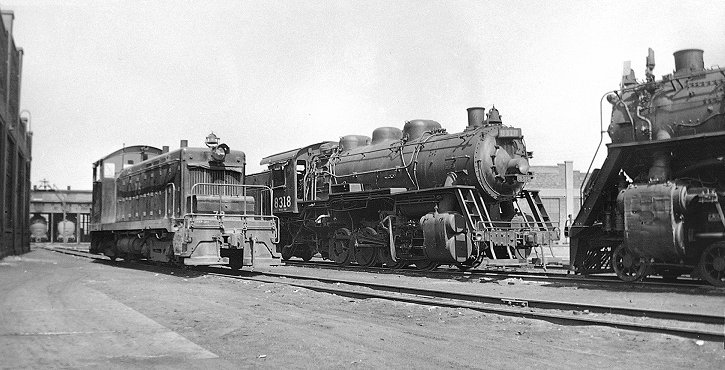
The GTW P-5 0-8-0s were sharing duties with diesel switchers as early as the late 1930s. In the scene below, taken at Battle Creek in the summer of 1953, P-5-b No. 8318 poses with Electro-Motive type SC switcher No. 78 erected in 1938, the GTW's first diesel switcher (not counting No. 7730, the 1929 Brill boxcab unit that switched the ferry docks in Milwaukee). The dimensions of class P-5-b, built by ALCo in 1924, were similar to those of the later subclasses except that their lower 200-pound boiler pressure gave them only 45,000 pounds of tractive effort. The locomotive at right is U-3-b 4-8-4 No. 6315. This photo is of special interest in revealing that at least this member of the U-3-b class had spoked pilot truck wheels; all other photos I have seen of these engines show solid pilot truck wheels. This locomotive also has a "cowcatcher" pilot, whereas most members of the U-3-b class had the cast steel pilot as shown on No. 6313 in the next photo. Both of these Battle Creek terminal photos appear in I. E. Quastler's book Grand Trunk Western Railroad: An Illustrated History (R&I Publishing, 2009).
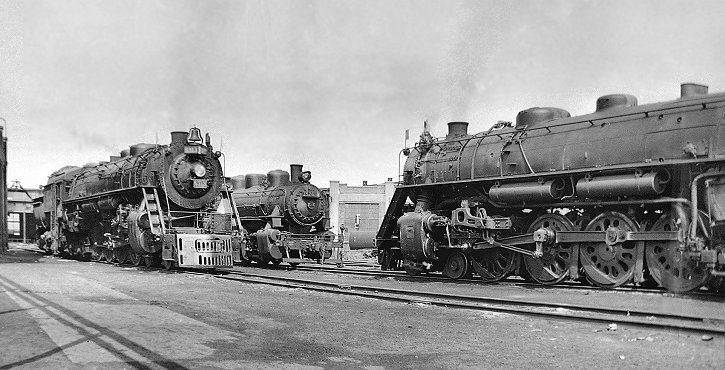
In addition to its eight-wheeled switchers, the Grand Trunk Western had eight 0-6-0 or six-wheeled switchers in class O. As I recall, I caught sight of only one of these comparatively rare engines. In the scene below at the Battle Creek shops from the summer of 1953, 0-6-0 No. 7526 peers bashfully between two of the class U-3-b Northerns, Nos. 6313 and 6333. These class O-19-a switchers were built by ALCo in 1919. They exerted 39,000 pounds of tractive effort and weighed 165,000 pounds. With low 51-inch drivers, they had cylinder dimensions of 21x28 inches and a boiler pressure of 190 pounds. No. 7526, because of its short wheelbase, was probably used to switch some industrial trackage in Battle Creek that had sharp curves.
A wheel arrangement so rare that it doesn't even appear in most lists of steam locomotive types was the 0-8-2. The Grand Trunk Western owned six of them; another user of the 0-8-2 was the Illinois Central. Actually, these engines had been converted from 2-8-2s by amputating the pilot truck. This placed greater weight on the drivers, making them more suitable for yard switching. No. 3523 was a member of class S-1-h, built in 1918 by Schenectady. She had 27x30-inch cylinders, 63-inch drivers, and a boiler pressure of 175 pounds. These locomotives pulled with 52,000 pounds of tractive effort.
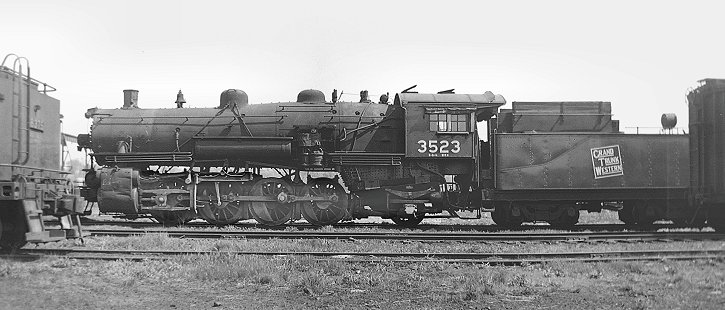
An unusual feature of No. 3523 is its Young valve gear, in which the valve mechanism drives directly off the cylinder crosshead. In this view the valve gear and main rod are disconnected, which in the 1950s was usually a sign that the locomotive was on its way to the scrap yard. However, when I came across No. 3523 at the GTW's Battle Creek shops in the summer of 1953 she was awaiting repairs. Returning to service, she became the last remaining 0-8-2 on the GTW roster when renumbered to 3522 in 1956. After photographing this engine in 1953, I saw 0-8-2s operating in the yards at Durand, Michigan. Larry Bell (mentioned above) wrote me as follows: "In Durand, the 3500s were used on the 'top end jobs' almost exclusively. They were nice riding compared to the 0-8-0's because of the trailer wheel. However they could be a difficult engine for a fireman, before conversion, because they had a long firebox and did not have a stoker. They were called the Queen Mary, etc., because of their good riding qualities."