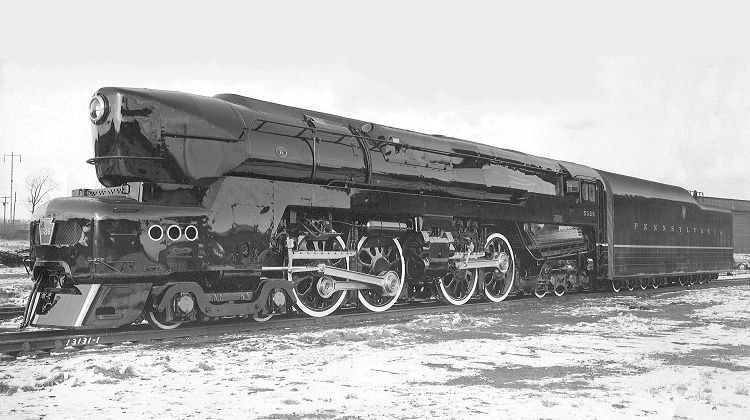
The Pennsylvania Railroad's T1 4-4-4-4 duplex drive locomotive has become a legend, for due to the advance of dieselization it had a brief service life. The first two (Nos. 6110-6111) were designed and built by Baldwin Locomotive Works in 1942, and the remaining 50 were erected in 1946 by the Pennsylvania's own Altoona Shops (Nos. 5500-5524) or by Baldwin (Nos. 5525-5549). The striking "shark nose" styling was by famed designer Raymond Loewy, and was emulated not only by Baldwin's "shark nose" diesels but by a group of 4-8-4s built for the South Australian Railways. This Baldwin builder's photo of Pennsylvania Railroad 4-4-4-4 No. 5526 shows the T1 class as originally built, with the "portholes" reminiscent of Buicks of the 1940s and 1950s. This image from the collection of my brother, David V. Leonard, shows off the original sheen of the T1's Brunswick green finish. In operation their paint job quickly faded to dingy black because Loewy's streamlining caused smoke to flow low over the engine, often obstructing the enginemen's view.
|
|
|