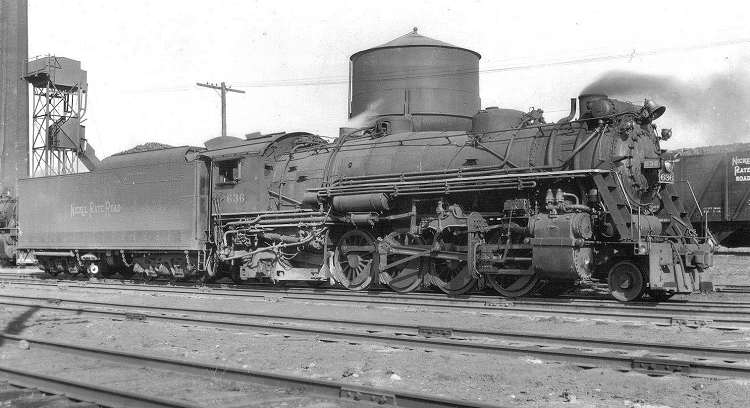
Although famous for its 80 class S Berkshires (2-8-4), the Nickel Plate Road actually rostered more Mikado or 2-8-2 type engines, owning a total of 107. (Counting the Lake Erie & Western and the Wheeling & Lake Erie, which the Nickel Plate absorbed, the totals were 111 Berkshires and 142 Mikados.) No. 636 of class H-6e appears here at Madison, Illinois, in this photo of indeterminate origin from the Gary Thompson collection. She rolled off the Lima Locomotive Works erecting floor in 1923. Her Elesco feedwater heater was a rare appliance among Nickel Plate locomotives, while the cylinder bracing (applied due to a tendency of the cylinders to crack) was typical of the H-6 class. For the specifications of the class, view the commentary for No. 662.
Charles Brinkley of La Grange, Missouri reports that this locomotive was wrecked at Edwardsville, Illinois in February, 1942, causing two crew fatalities including the engineer, a cousin of Mr. Brinkley's grandfather. No. 636 was wrecked again at Findlay, Ohio in 1943 (Ray Breyer provided me with a photo of the wreck) and apparently this "jinxed" engine was removed from service at that time and never rebuilt, although her number was not stricken from the NKP roster until 1945. Three Nickel Plate 2-8-2s are preserved, including H-6e sister No. 639 on display in Miller Park, Bloomington, Illinois, and No. 624 which has been acquired by the Fort Wayne Railroad Historical Society for display and possible future operation.