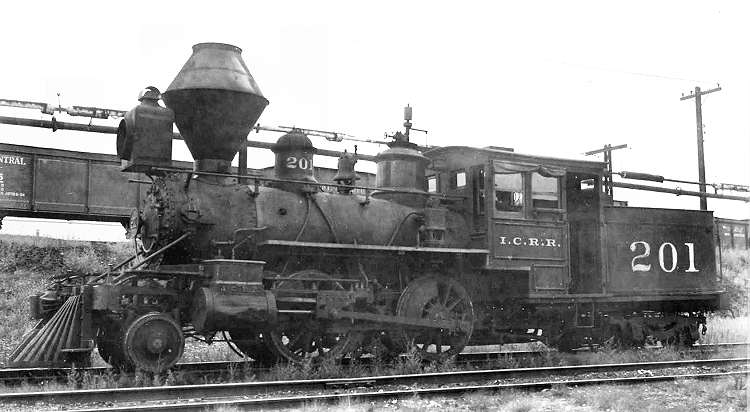
Illinois Central No. 201 is a 2-4-4T, or "tank," locomotive built in 1880 by the Rogers Locomotive and Machine Works of Paterson, New Jersey. This configuration, with the coal bunker and water tank positioned over the trailing truck, is known as the "Forney" after its designer, IC employee Matthias N. Forney. The advantages of this design are that it can operate with ease in either direction and negotiate tight curves; Forneys, therefore, were widely used on elevated railways in large cities or in commuter service with rapid turnaround schedules. The Illinois Central used such engines in Chicago suburban service prior to the beginning of electrification in 1926. Weighing a modest 107,600 pounds, No. 201 had 16x22-inch cylinders with the square slide valve steam chest, 56½-inch drivers and a boiler pressure of 140 pounds. These specifications would give it a tractive effort of 11,860 pounds. This photo of unknown source appears here courtesy of Tom Rock of Rock on Trains. The location is the Illinois Central's shops area in Paducah, Kentucky, where the images of Nos. 3615, 2502 and 2614, shown in this collection, were taken. Consequently the photo is probably to be dated in the late 1940s.
One source states that famed IC engineer James Luther "Casey" Jones was temporarily transferred to Chicago suburban service during the 1893 World's Columbian Exposition in Chicago, and it is likely that No. 201 was one of the engines he ran. As the first of the 2-4-4T suburban locomotives and the only surviving engine possibly operated by Casey Jones, it was deemed to be of historical value and in 1928 the Illinois Central reportedly sold it to the Rosenwald Industrial Museum, predecessor of today's Museum of Science and Industry in Chicago. However, the IC seems to have retained the use of the engine for publicity purposes, and applied the fake antique diamond stack and old-style oil headlight when it was displayed in connection with the completion of suburban electrification in 1932. The locomotive also participated in the "Wheels-a-Rolling" pageant at the Chicago Railroad Fair of 1948-49, at which time its number was restored to 201, the number it had when allegedly operated by Casey Jones. In the early 1960s No. 201 left the IC property and was displayed at Vonachen's Old Place Restaurant in the Junction City Shopping Center in Peoria. Later it was displayed in Owatonna, Minnesota, before joining the collection of the Illinois Railway Museum. For a photo of it as it appears today, click here. I am greatly indebted to Ray Breyer for supplying, or confirming, many of these details about the history of No. 201.