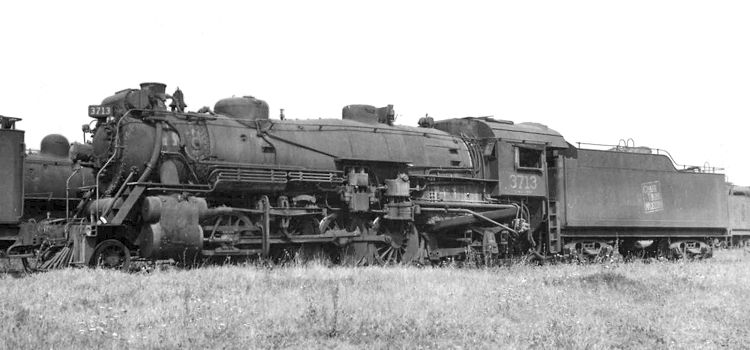
After the bankrupt Grand Trunk Railway was absorbed into the Canadian National Railway in 1923 its lines in the United States came to be operated under two names: Grand Trunk in New England, and Grand Trunk Western in Michigan, Indiana and Illinois. Some classes of steam power were shared between these two U.S. components, including the 40 members of the S-3-a class of 2-8-2s. Erected by American Locomotive Company's Schenectady Works in 1918, the S-3 class followed the USRA light Mikado design, with this first group weighing in at 290,000 pounds. For their other specifications, see the commentaries on Nos. 3747 and 3748. In an image provided by Tom Rock of Rock on Trains No. 3713, of the Grand Trunk Western, appears here at an unknown location perhaps at the end of its service life in 1953. In 1956 the remaining members of the S-3 class were renumbered into the 4000 series to make room for new diesels, but No. 3713 had met its demise was not included in the renumbering. Its original Grand Trunk number was 453.
|
|
|