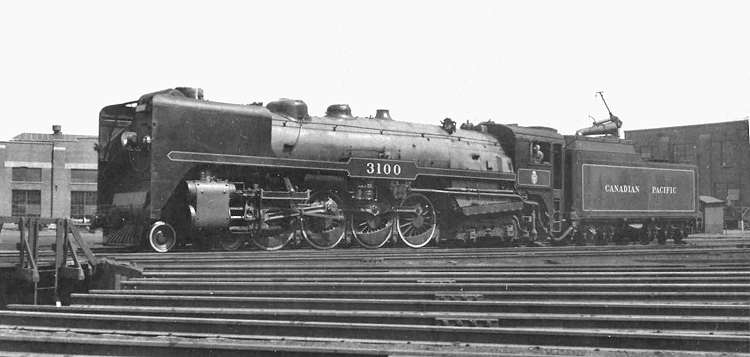
The diesel era brought a measure of uniformity to the motive power fleets of North American railroads. In the days of steam, however, each railroad pursued its own distinctive motive power policy. As a case in point, the Canadian National Railway System owned 203 4-8-4s, more than any other railroad. Traversing the same territory under the same conditions, the Canadian Pacific rostered only two, Nos. 3100 and 3101 of class K1a. They were built in 1928 in the CPR's own Angus Shops with 75-inch drivers, 25½x30-inch cylinders, and a boiler pressure of 275 p.s.i. Weighing a total of 709,000 pounds with tender, they were rated at 60,800 pounds of tractive effort. They were eventually converted to oil burners. Although designed as dual-service locomotives, they reportedly held down a nighttime passenger and mail run between Toronto and Montreal through most of their careers, so photos of them in action are scarce. This view of No. 3100 on the turntable in Toronto was provided by Tom Rock of Rock on Trains, but information concerning the photographer and date is lacking.
|
|
|