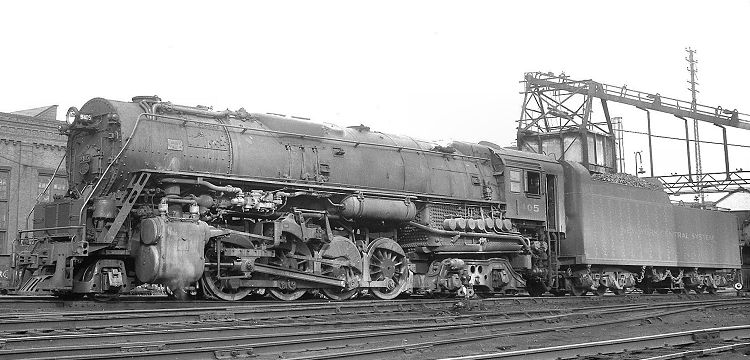
Pittsburgh & Lake Erie 2-8-4 No. 9405 appears at an unidentified location around 1950; the photographer is unknown, but the image comes from my late brother David Leonard's collection. These locomotives developed a tractive effort of 67,300 pounds. Whereas most modern Berkshire type locomotives had a driver diameter of 69 inches, the A-2s rolled on 63-inch drivers more suitable for their duties on the P&LE, which served the steel industry and had heavy coal and ore traffic. They had 26x32-inch cylinders and a boiler pressure of 230 p.s.i., and weighed in at a hefty 436,000 pounds. Their grate area measured 95 square feet, their evaporative heating surface 4275 square feet, and their superheating surface 1880 square feet.
By the time the P&LE Berkshires entered service dieselization was already advancing across the New York Central System, beginning in the East. In fact, P&LE management preferred to order diesels but was overruled by parent New York Central in favor of the A-2s, the final steam project of famed NYC steam designer Paul W. Kiefer. By the early 1950s the A-2s had been withdrawn from service on the Pittsburgh & Lake Erie, but were taken out of storage in 1955 and transferred to former "Big Four" lines in Ohio and Indiana; they may be seen in this service in the Herron video New York Central, Volume 2. All were retired by mid-1956 and scrapped the following year, having known one of the shortest life spans of any steam locomotive of modern design.