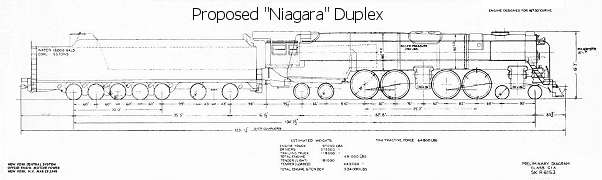
The Pennsylvania Railroad's T-1 duplex drive locomotives, introduced in 1942 and produced in quantity in 1945-46, were the epitome of modern steam design in the United States with their poppet valves and striking "shark nose" streamlining. At the same time the New York Central was introducing its efficient but more conventional Niagara 4-8-4s. Not to be outdone by rival Pennsy, the Central's Motive Power Engineering Department proposed a design for a duplexed version of the Niagara, to be classed C-1a. (See the 1945 elevation, below). Class C had been assigned to the 4-4-0 or American type on the New York Central, but by 1945 the last of the 4-4-0s in Class C-97b had been retired for several years.
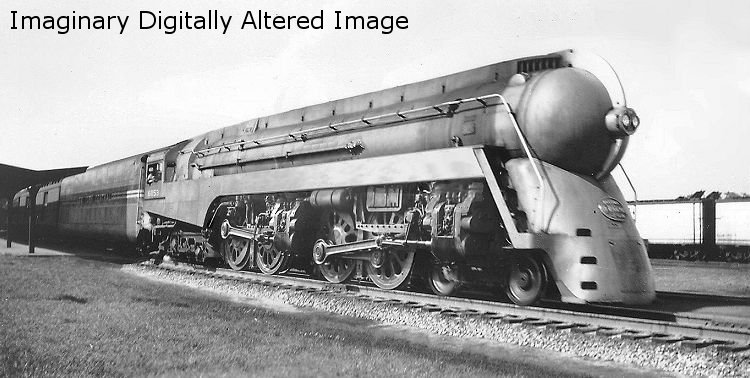
The elephant-eared Niagara duplex was never built. Instead the Central, working with favored builder American Locomotive Company, borrowed the Dreyfuss streamlining of the ten last J-3 Hudsons of 1938 to create a main line duplex passenger locomotive as striking as the Pennsy's famed T-1. The five members of this eventual class C-1a, Nos. 6050-6054, performed well but were not repeated. A few lasted till 1964. Unlike the streamlined J-3 Hudsons, the C-1s kept their shrouding till they were scrapped. Here No. 6053 pauses at Chicago's Englewood station with the Commodore Vanderbilt.
A New York Central "Fantasy Steam" Feature
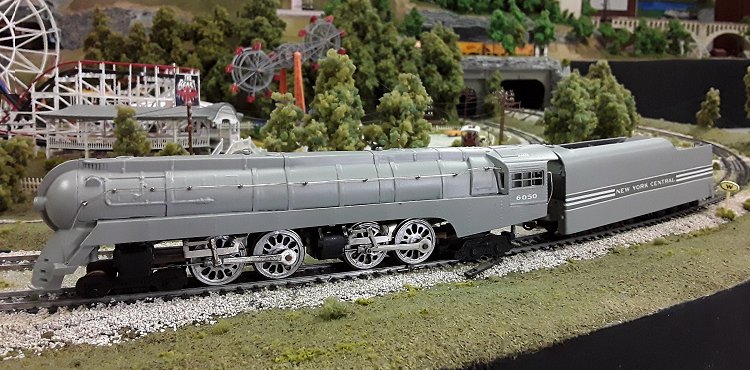
In 2019, viewer Eric Pratt provided this image of his HO scale model of the imaginary C-1 duplex.