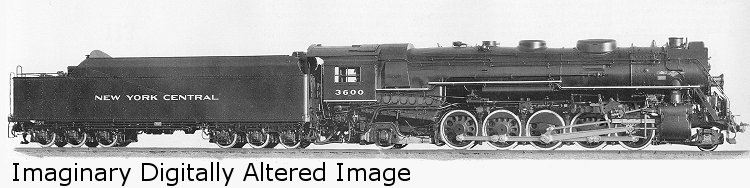
The New York Central, through its Boston & Albany lessee, pioneered the use of the "Superpower" steam locomotives with the A-1a 2-8-4s of 1926. The Superpower designs, developed by Lima Locomotive Works, featured a larger firebox and four-wheel trailing truck for improved steam-producing capacity. These locomotives quickly supplanted older and slower types like the 2-10-2. It is ironic, then, that in 1950 the New York Central took delivery from Lima of twelve 2-10-2s of class Z-2a, Nos. 3600-3611.
These were not the first 2-10-2s operated by the New York Central System. ALCo had built ten class Z-1a locomotives in 1919 for the Boston & Albany, Nos. 1100-1109. In 1926 they were sent to the NYC's subsidiary CCC&StL, but were sold to the Canadian National in 1928. The Z-2a class of 1950 came to the Central after a gap of some twenty-odd years during which 2-10-2s were absent from its roster. They were the first engines of this wheel arrangement delivered to a North American railroad since 1931.
There was nothing remarkable about their design, which was based essentially on the L-3 Mohawks, but with their weight spread over five driving axles they were better suited for the West Virginia lines and some branches with load limits that excluded the Mohawks or Berkshires. They had 67-inch drivers, and their wheelbase was only a little longer than that of the L-3s. In 1966, just before the class was retired, a visiting group of Chinese Railway officials observed the Z-2s in operation with a view to incorporating some of their features into their QJ 2-10-2 design. However, with the onset of the Cultural Revolution their plans were thwarted, and the QJs (some still operating in parts of China) never reached the standard set by the Central's Z-2a class.
A New York Central "Fantasy Steam" Feature