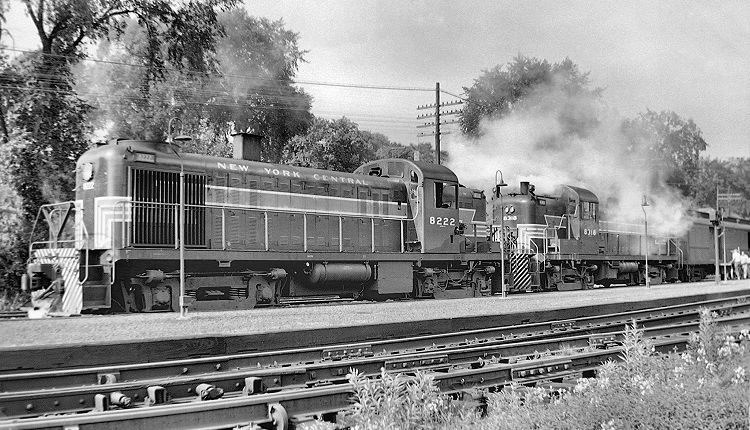
The ALCo RS-2, with its type 244 prime mover, developed 1500 horsepower, and the RS-3 produced 1600 horsepower. They were used in passenger service on the New York Central's eastern lines, as in this August 1955 view of RS-2 No. 8222 and RS-3 No. 8318 at the depot in Pittsfield, Massachusetts. The train is the westbound Knickerbocker, train No. 49, which called at Pittsfield around 3:00 p.m. (Later that year it was rescheduled and renumbered to 41.) The idling lead unit is putting out the usual ALCo smoke, and the second appears to be emitting quite a bit of steam from its generator, which in August would most likely have been used for train air conditioning.
ALCo RS-1, RS-2 and RS-3 models had different pin configurations on their multiple unit connections. Some sources say this prevented their being mixed in multiple unit configuration — controlled by the engineer in the lead unit — although other sources assert they could me run in MU without modification. The practice apparently differed from railroad to railroad; regardless of the jumper connections, differing brake types between diesel models (or even within the same model) required skill on the engineer's part when operating them in multiple consist. Reportedly the NYC's RS-3s were all equipped for multiple unit operation at the "B" or cab end so the second unit of an MUed pair would be running "backwards" (the NYC considered the long hood as the front). It is known that the lead unit, RS-2 No. 8222, had no MU connection on the front.
Viewer "bill8106" very kindly comments, "I've always admired this photograph, so much is captured in it. Side-by-side comparison of an RS-2 vs RS-3, ALCo smoke, escaping steam, Hancock whistle on 8222, gooseneck lightposts, fuel stain on 8222's cab...I can go on and on. Terrific RR photo of that era." And thanks to Michael F. Rossi and Gordon Davids for supplying helpful information about this photo via "The Tack Board," a department of Central Headlight, the magazine of the New York Central System Historical Society.