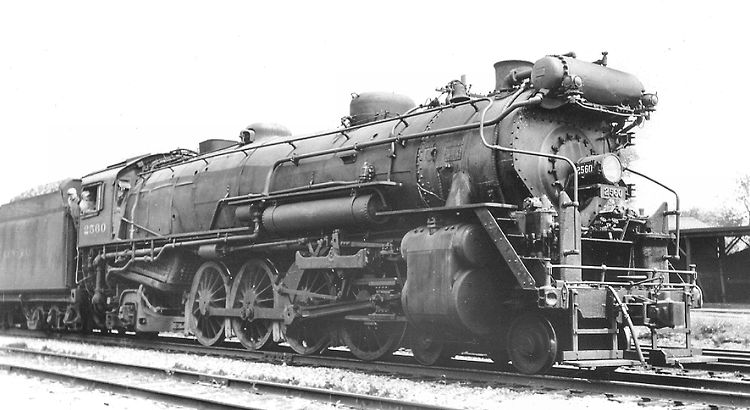
No information is forthcoming about this photo of 4-8-2 No. 2560 of class L-1b. Members of this class had 69-inch drivers, a boiler pressure of 200 p.s.i., and 28x28-inch cylinders. Like many steam locomotives, No. 2560 and her sisters went through extensive rebuilding and fitting with new appliances; the Elesco bundle-type feedwater heater and the one-piece cast trailing truck, with booster, were not original equipment. They weighed 343,000 pounds as delivered, but weight increased to as much as 364,500 pounds as new features were applied. As rebuilt they developed a tractive force of 54,080 pounds, with a booster on most members of the class adding 11,000 pounds (for other dimensions see the commentary for No. 2545, previous). Although most L-1 Mohawks were among the relatively few NYC System locomotives not affected by the 1936 renumbering, in 1937 this locomotive was transferred to the Peoria & Eastern and renumbered to 39; she was taken out of service in 1951.
|
|
|