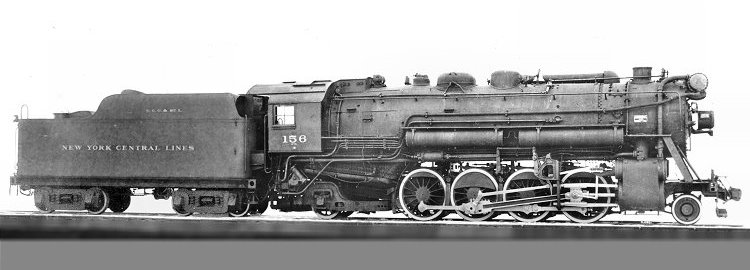
New York Central No. 2256, shown here in a builder's portrait as "Big Four" (CCC&StL) No. 156, was a member of the H-10a group delivered in 1923 by the American Locomotive Company, as evidenced by her builder's plate. Not long after delivery this engine was used in a series of tests to determine the optimum back pressure (exhaust steam pressure in the cylinders) to produce maximum locomotive horsepower. She was renumbered to 2256 in 1936, and retired in 1950. Locomotives of the H-10 class had 28x30-inch cylinders, 63-inch drivers, and a boiler pressure of 200 p.s.i. They weighed 342,500 pounds and developed 63,470 pounds of tractive effort, with a booster adding 11,000 pounds. Later the H-10s received a larger twelve-wheel tender in place of the smaller tender seen here.
The improved steaming capacity of the H-10 led to the appearance of the "superpower" 2-8-4 type, the four-wheel trailing truck being needed to support an even larger firebox. The Central's Boston & Albany subsidiary was the first to operate the new type, eventually having 55 Class A locomotives. The 2-8-4 took its name "Berkshire" from the New England mountains traversed by the B&A.