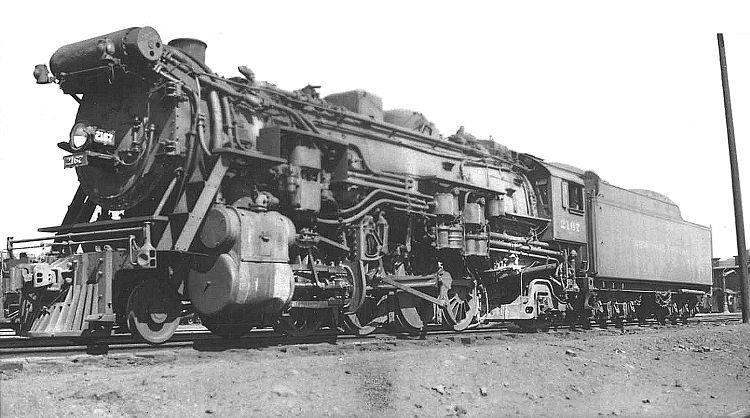
This view of New York Central 2-8-2 No. 2167 affords a good view of the locomotive's pilot. The "cowcatcher" or road pilot was normal for New York Central passenger locomotives, but not for freight locomotives except in Canada. Other than the dual-service L-3 and L-4 Mohawks built in the 1940s, NYC freight power typically featured the footboard pilot. However, the New York Central applied the "cowcatcher" pilot to many older locomotives in road freight service across the system; on the Michigan lines it was applied especially to the H-10 and L-2 classes. Surprisingly, it was fabricated not from steel but from wood; as a boy of seven I saw unpainted wood pilots at the NYC's Jackson, Michigan shops.
A member of class H-10a, No. 2167 was the former No. 67 delivered by the American Locomotive Company in 1923 She shared the dimensions given in the commentary on No. 2256. The H-10s had a grate area of 66.6 square feet, with 4515 square feet of evaporative heating surface and 1780 square feet of superheating surface. No. 2167 was taken out of service in 1952. This photo, which came to our collection from Tom Rock of T.D.R. Productions, was probably taken in Detroit around 1940 by a Canadian railfan who had crossed the river from Windsor, Ontario. It was reproduced on page 21 of the first quarter 2019 issue of New York Central Modeler, online publication of the New York Central System Historical Society.