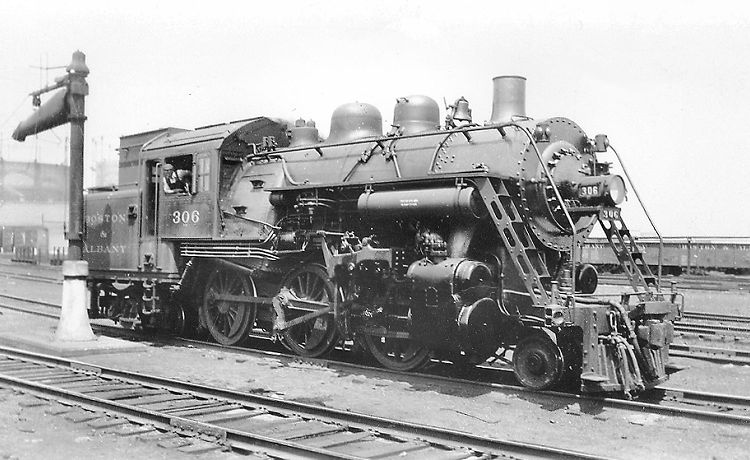
A tank engine is a locomotive that carries its water and fuel supply on the same frame as the boiler and running gear, eliminating the need for a separate tender. Tank engines, also called "double-enders," are more easily operated in reverse than those with tenders. Several North American railroads used them in suburban service, where a full schedule of trips each day required a quick turnaround of their trains. In 1906 the Boston & Albany received an order of 2-6-6T tank engines from the American Locomotive Company, the rear six-wheel truck supporting the coal bunker and water tank. No. 306 was a member of this class L-3.
When ALCo delivered a group of larger and more powerful class D-1a 4-6-4T double-enders in 1928 (see the following page), the B&A sent the older L-3 2-6-6Ts to the Lima Locomotive Works for rebuilding in 1928 through 1930. In 1940 they were reclassified to D-2a to avoid conflict with the new class L-3 Mohawk types of the New York Central. As rebuilt, the 2-6-6T double-enders had 23x24-inch cylinders and a boiler pressure of 200 p.s.i. They weighed 172,700 pounds and developed 26,800 pounds of tractive effort. The rebuilt No. 306, which was retired in 1950, is shown here in a view taken in Boston on July 12, 1933 by Roy F. Blackburn of Eldon, Missouri. Ron Morse of Springfield, Missouri, is the current owner of this photograph.